The Difference Between a Brand Designer and a Brand Strategist (And Why It Matters)
These two terms get used almost interchangeably in a lot of marketing copy, including, if I am honest, some of my own early website copy before I tightened it up. That is part of the problem. The roles are genuinely different, and not knowing the difference is one of the more common reasons brand projects underdeliver.
This post explains what each role actually does, why the distinction matters when you are commissioning work, and where a combined approach fits into the picture.
What a Brand Designer Actually Does
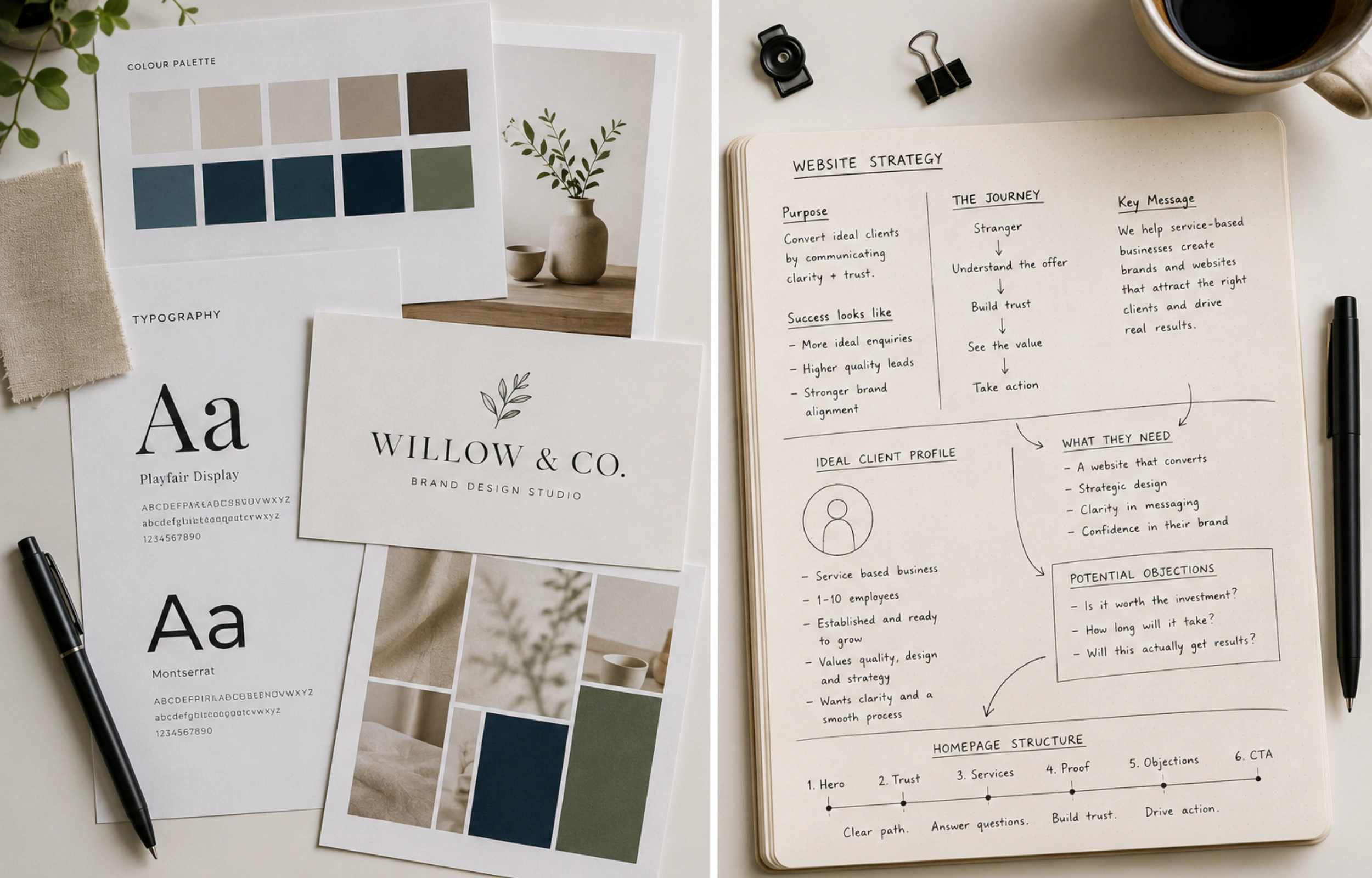
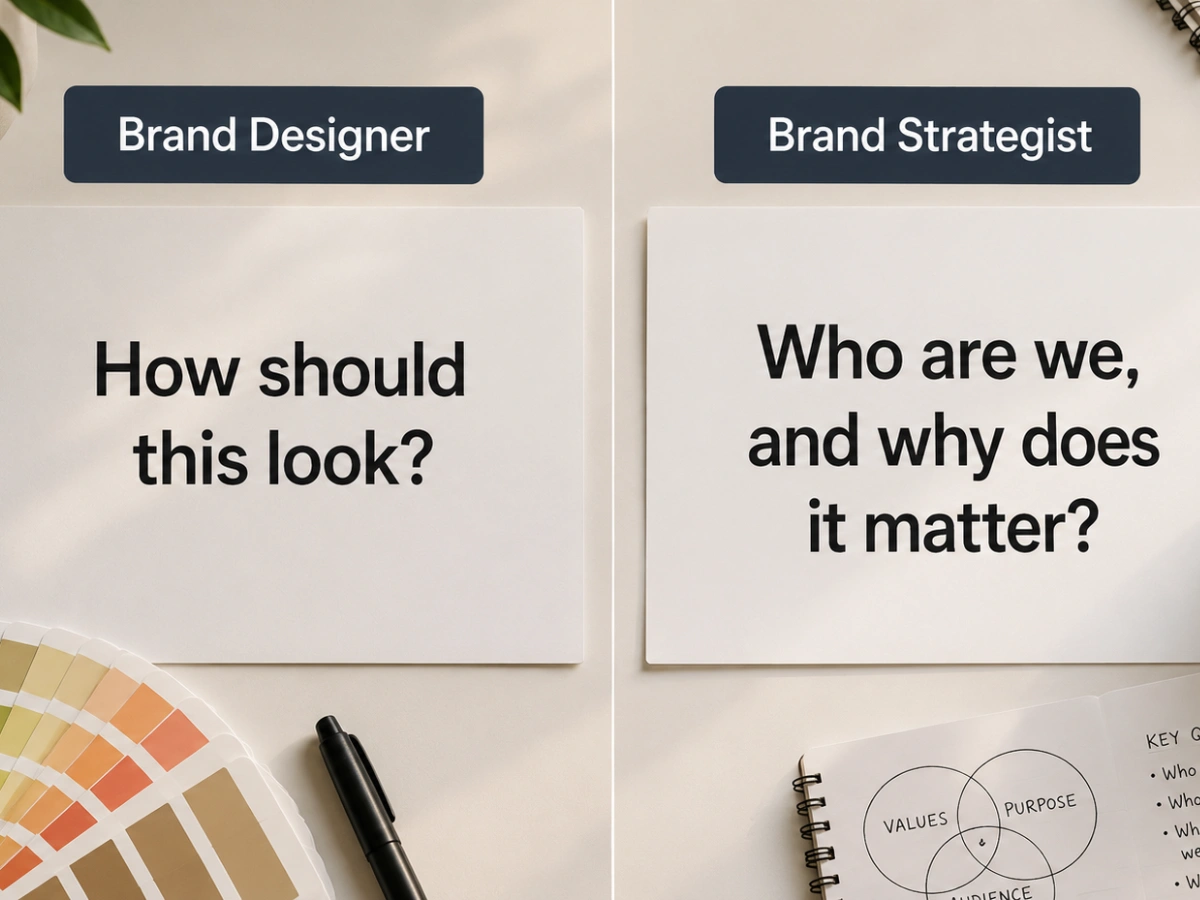
A brand designer's core question is how should this look. Given a brief, a designer creates the visual expression of a brand: the logo, the colour palette, the typography, the overall visual system that gets applied across a website, social media, and printed materials.
This is genuinely skilled work. Good brand design requires an understanding of colour theory, typography, composition, and how visual choices create specific emotional and perceptual effects. A skilled designer can take a reasonably clear brief and produce something that looks polished, current, and distinctive.
The limitation is built into the question itself. A designer working purely on the visual brief is solving for how something looks, not for who the business is, who it serves, or what makes it different. If those questions have already been answered clearly before the design brief is written, a designer can do excellent work. If they have not, the design has to make assumptions, and those assumptions do not always hold up.
What a Brand Strategist Actually Does
A brand strategist's core question is who are we, and why does it matter. The work here is research and thinking rather than visual production. Defining the ideal client with real specificity. Clarifying the positioning relative to competitors. Establishing the core message and the proof that supports it. Mapping the customer journey from first contact to enquiry.
This work produces no visual output at all. The result is usually a written strategy document: a positioning statement, an ideal client profile, key messaging pillars, and a clear articulation of what makes the business different and why that difference matters to the people it serves.
Done well, this strategic work becomes the brief for everything that follows. It tells a designer what the visual identity needs to communicate. It tells a copywriter what language to use and avoid. It tells a web developer what the user journey needs to achieve. Without it, every one of those downstream decisions is being made on assumption rather than evidence.
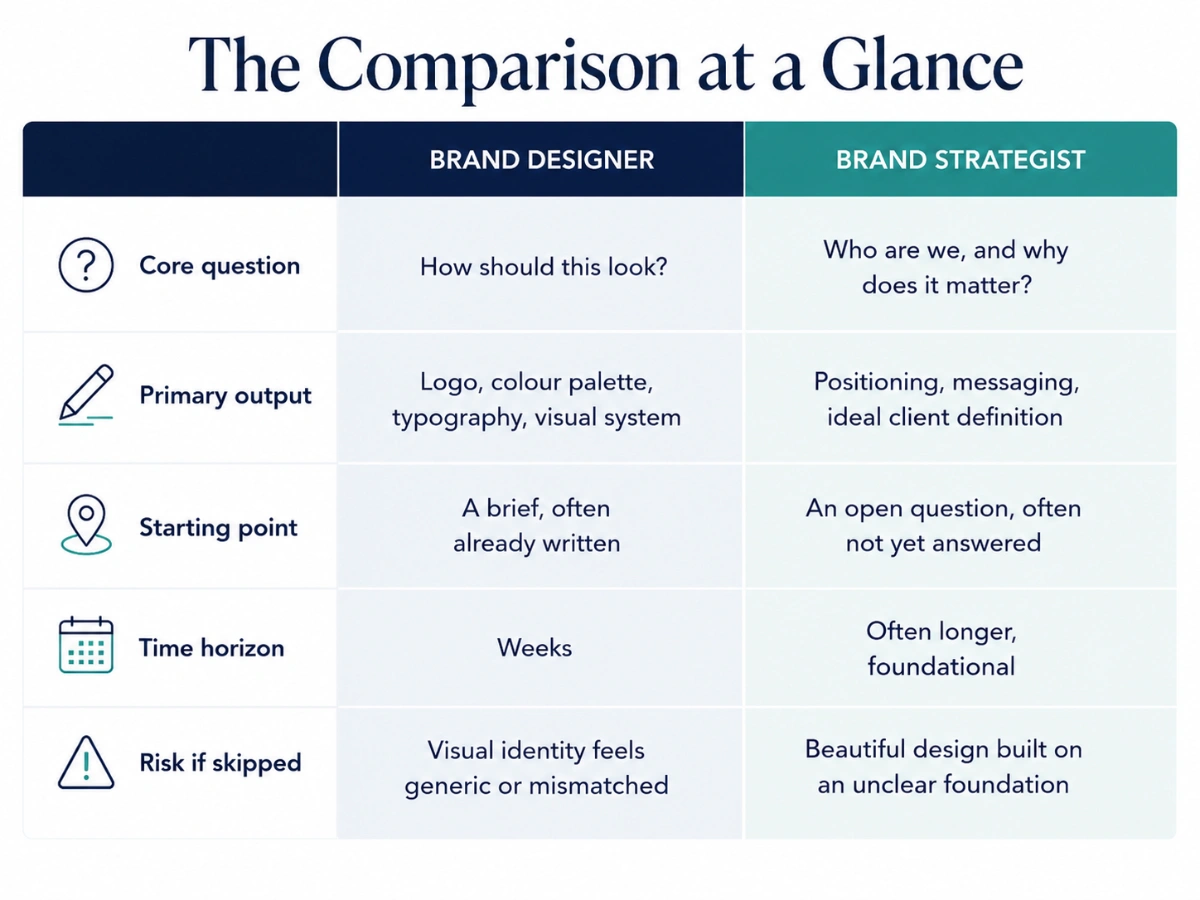
The Comparison at a Glance
Not sure whether your business needs strategy, design, or both?
Book a free discovery call with Hayley. We can talk through where your business is and what kind of work would actually move it forward.
Why the Distinction Matters When You Are Hiring
Skipping the strategist produces beautiful guesswork
If you commission a logo and visual identity without a clear strategic foundation, a skilled designer can still produce something visually impressive. What it often cannot do is hold up under scrutiny when you try to explain why it looks the way it does, or why it should resonate with your specific ideal client rather than a different one.
This is the most common pattern I see in client work that comes to me for a refresh. The visual identity is not poorly made. It is well made, but built on an assumption about the business that was never actually tested or confirmed, and the business has since outgrown or diverged from that assumption.
Skipping the designer leaves the strategy undelivered
The reverse problem also happens. A business invests in strategy work, ends up with a strong positioning document and a clear sense of its ideal client, and then has nowhere for that thinking to live. Strategy that never gets expressed visually and verbally across a real brand and website produces no commercial result. It is a well-reasoned plan sitting in a folder.
Some people offer both, and that has trade-offs in either direction
Some practitioners, myself included, do both strategy and design work for clients. This can work very well, because the same person carrying the strategic thinking into the visual execution tends to produce more coherent results than a handoff between two separate people who never fully align.
The trade-off is that doing both well requires genuine competence in two quite different skill sets, research and analytical thinking on one side, visual and creative execution on the other. Not everyone who offers both is equally strong at both. Worth asking, when evaluating a combined offering, for evidence of the strategic thinking specifically, not just the visual portfolio.
What Is the Difference Between a Brand Designer and a Brand Strategist?
A brand designer answers how should this look, producing the logo, colour palette, and visual system. A brand strategist answers who are we and why does it matter, producing the positioning, messaging, and ideal client definition that the design is meant to express. Hiring a designer without a strategist usually produces a beautiful identity built on an unclear foundation, which tends to need revisiting once the business has to explain who it actually serves.
How I Approach This at WQ Creative
This distinction is exactly why brand strategy is the first stage of every project I take on, regardless of what the client initially thinks they are asking for. If someone reaches out wanting a new logo, the first real conversation is still about who their business serves and what makes them different, because that thinking needs to exist before any visual decision is made.
I do both roles deliberately, not because doing both is inherently better, but because I have seen what happens when the two are separated without a clear handoff. The strategy gets diluted in translation, or the design gets built around an interpretation of the strategy that was never quite confirmed. Carrying the thinking through from research to visual execution avoids that gap.
If you are evaluating who to work with on brand work, the most useful question to ask either a designer or a strategist is simply: how do you make sure the strategy and the design stay connected. The answer tells you a great deal about how seriously the distinction is being taken.
Strategy first. Design that expresses it. That is the whole approach.
At WQ Creative, every brand project starts with the strategic thinking before a single visual decision is made. Book a free discovery call with Hayley to talk through what your business actually needs.


.png)