Template vs Custom Website: Which One Is Right for Your Business?
This is a question I get asked regularly, and I want to give you a more useful answer than the typical 'it depends on your budget and goals' response that most guides land on.
The honest version is this: both can work, but they work for different businesses at different stages, and the cost of choosing the wrong one is higher than most people realise when they are making the decision.
I build custom Webflow websites for service businesses, so I have a clear view of what templates can and cannot do, and I have worked with plenty of businesses that came to me after spending time and money on a template that was not serving them. This post is my genuine take on when each option makes sense and how to know which one you actually need.
What a Template Website Actually Is
A template website uses a pre-designed layout built on a platform like Squarespace, Wix, or Showit. You choose a template, swap in your content, adjust colours and fonts to approximate your brand, and publish. The platform handles hosting, updates, and the technical infrastructure.
There is nothing inherently wrong with that. These platforms have improved substantially over the last several years and the better templates are genuinely well-designed. For a business that needs to get online quickly and does not yet have a clear sense of its positioning, a template is a reasonable way to establish a basic online presence without a large upfront investment.
The issue is not the template itself. The issue is what a template cannot do, and how quickly those limitations start to matter as a business grows.
What templates cannot do
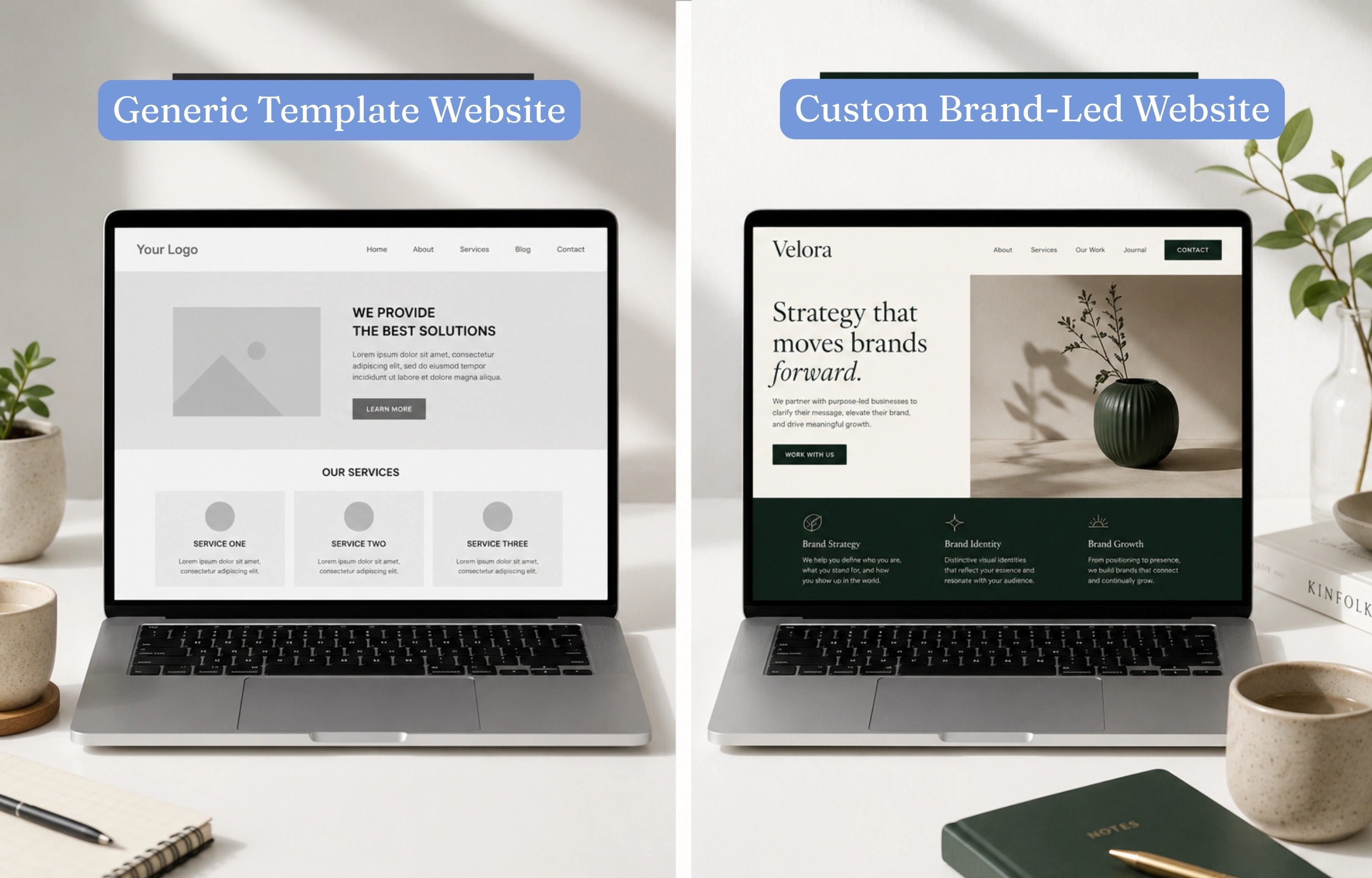
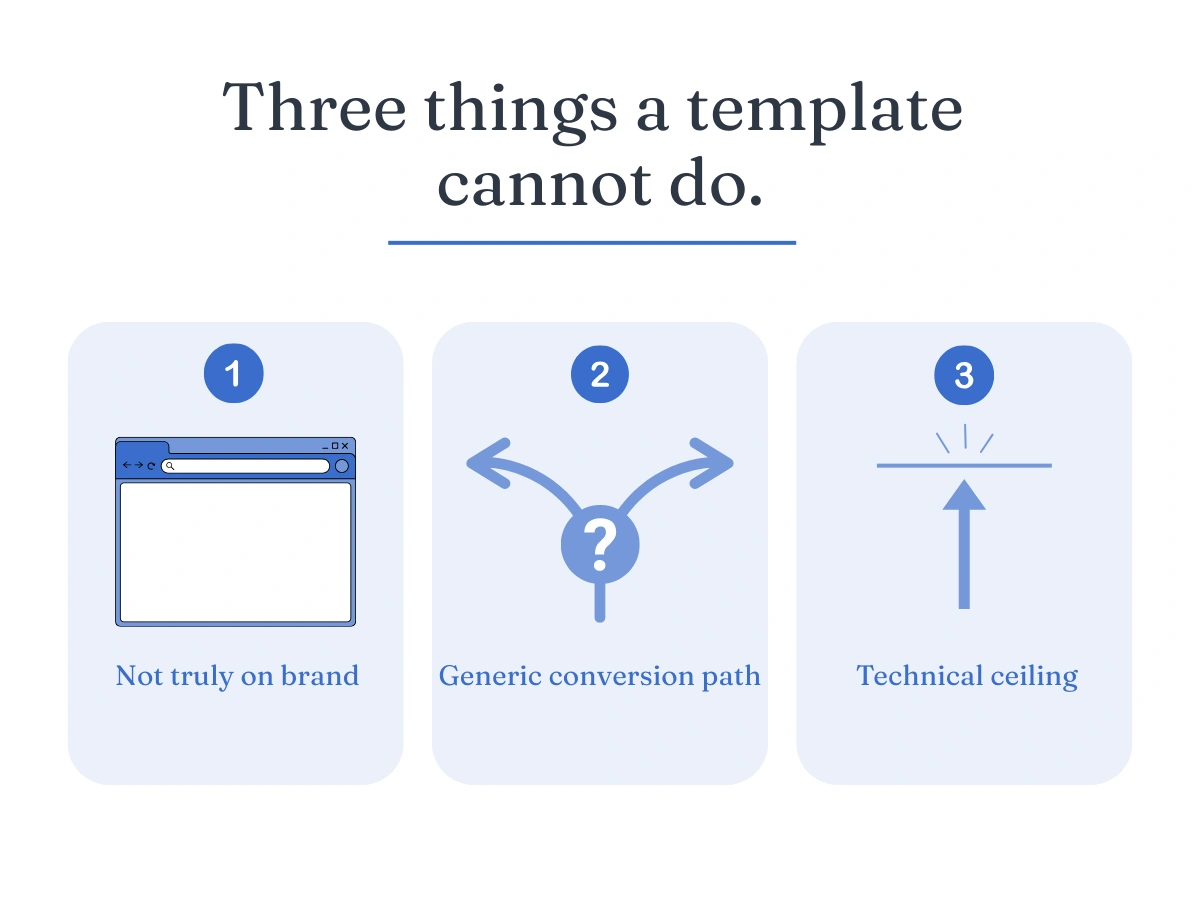
They cannot be truly on-brand. A template is designed to be adaptable to many businesses, which means it is not designed specifically for any of them. You can get close by adjusting colours and fonts, but the underlying structure, the proportions, the way sections relate to each other, the decisions about hierarchy and emphasis, those belong to whoever designed the template. Your brand ends up wearing someone else's clothes.
They cannot be optimised for your specific conversion goal. A well-built custom site is structured around a specific user journey: this type of visitor, with this type of problem, needs to move through the site in this way and arrive at this action. A template has a generic user journey baked in. You can adjust the content within it, but you are working within someone else's assumptions about how visitors should move through a website.
They carry technical ceilings. Platform restrictions vary, but most template-based platforms limit your control over page speed, SEO structure, custom functionality, and the ability to build out more complex pages as the business grows. Some of those ceilings matter immediately. Others only become apparent later, at the exact moment you need more from the site.
What a Custom Website Actually Is
A custom website is built specifically for your business, your brand, and your conversion goals. The design starts from your strategy rather than from a pre-existing layout. Every decision (the structure of the homepage, the way services are presented, where proof appears, how the call to action is framed) is made with your ideal client and your business objectives in mind.
At WQ Creative, I build custom sites on Webflow. Webflow is a visual development platform that gives full design control without the technical constraints of template platforms, and produces clean, fast, SEO-ready code. It is not the only platform for custom work, but it is the one I recommend for service businesses because of the combination of design flexibility, performance, and ease of content management once the site is live.
The honest trade-off with custom is time and cost. A well-built custom site takes longer to produce and costs more than a template. That is not a reason to avoid it. It is a reason to make sure you are investing in it at the right stage, when the business is positioned to get the full return from it.
Not sure which option is right for where your business is right now?
Book a free discovery call with Hayley. We can look at your current situation and work out whether a template refresh or a custom build is the right next move.
When a Template Makes Sense
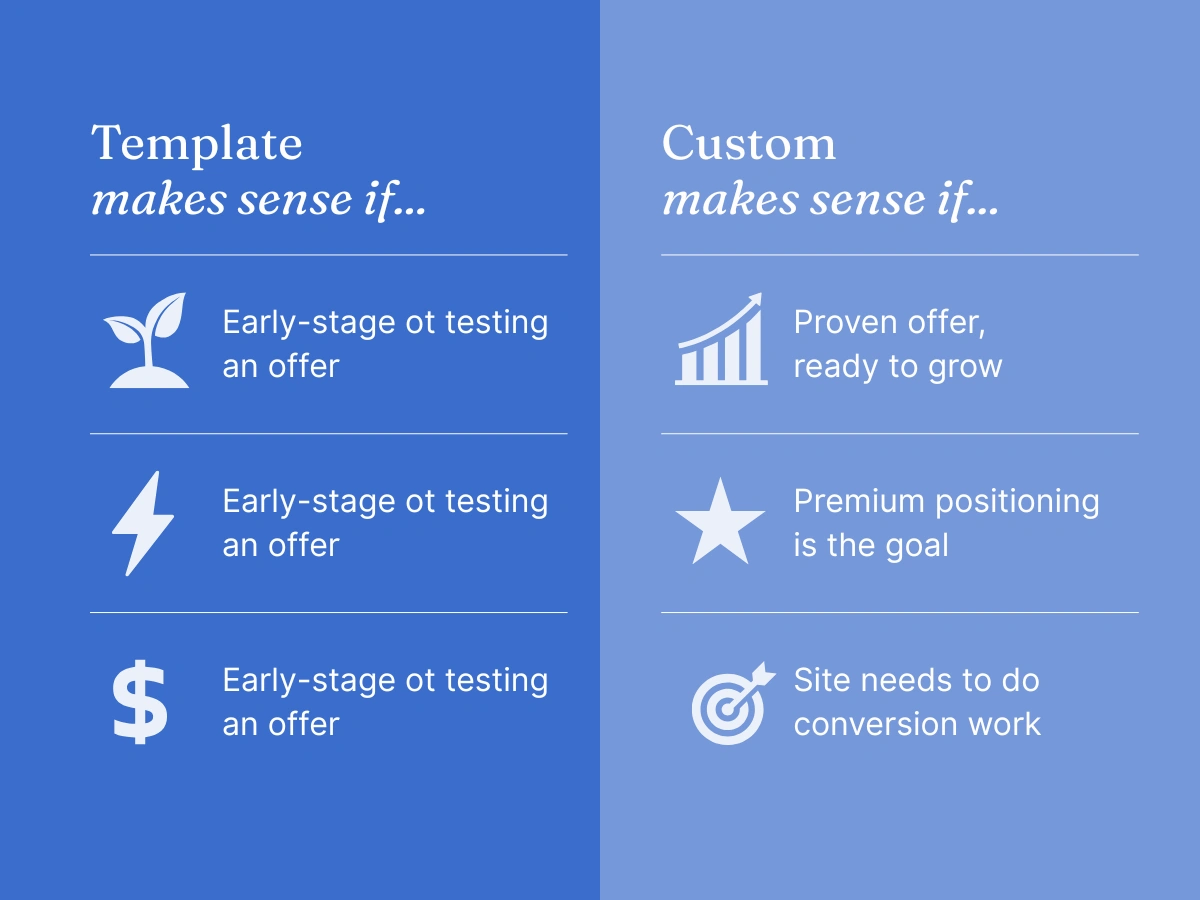
A template is the right choice when you are at an early stage, your offer is still being refined, and the primary goal is simply to have an online presence that is clear and functional.
If you are a new business, a sole trader testing a new service, or someone who needs to get online in a matter of weeks with a limited budget, a well-chosen template on a solid platform is a reasonable starting point. Done well, it can be clean, professional, and serviceable.
The conditions that make a template work are: you have clear messaging, you use quality photography, and you do not try to make the template do more than it is designed to do. A template with strong copy and good images will almost always outperform a custom site with weak copy and stock photography.
The real cost of a template
The cost of a template is not just the monthly platform subscription. It is the opportunity cost of the clients and rates you do not capture because the site is not doing its full job.
A template limits your ability to communicate a premium positioning. It limits your control over the user journey and the placement of trust signals. It puts a ceiling on your SEO performance. And it tends to look similar to other businesses using the same template, which is a problem when your goal is to stand out in a crowded market.
Most service businesses that come to me after using a template for a year or two say the same thing: they knew it was not quite right, but they kept pushing the work off. The money they spent on the template period was not wasted, but the revenue they could have captured with a stronger site was real, and in hindsight the gap between template cost and custom cost feels much smaller than it did at the time.
When a Custom Website Makes Sense
A custom website makes sense when your business has passed the validation stage and you are ready to grow in a more intentional direction. You have a clear ideal client. You understand what you do and who it is for. Your rates are at a level where the site needs to support, not undermine, the price you are asking.
It also makes sense when you have specific needs that a template platform cannot meet. A particular type of intake process, a portfolio that needs to work in a specific way, an integration with other tools in your business, or a level of visual and brand specificity that a template simply cannot achieve.
The Webflow advantage for service businesses
One of the reasons I build on Webflow specifically is that it removes the ceiling that most template platforms hit. Design is not constrained by a grid or a set of pre-built sections. The code it produces is clean and fast, which matters for both user experience and SEO. And the CMS makes it straightforward to manage blog content, case studies, and service pages without needing a developer every time something needs updating.
For a service business that is serious about using its website as a growth tool rather than just a presence placeholder, Webflow sits at the right intersection of flexibility, performance, and manageability.
The Question That Actually Decides It
Should I use a template or custom website for my service business?
A template is a reasonable starting point for a business that is still establishing itself and needs to get online quickly and affordably. A custom website makes sense when the business has proven its offer, is ready to grow beyond referrals, and needs a web presence that accurately reflects its quality and converts visitors into clients. The honest answer is that most service businesses outgrow a template faster than they expect.
The practical question to ask is not 'can I afford a custom website' but 'what is my current website costing me in missed enquiries, softened rates, and clients who visit and leave without making contact.'
If the answer to that question is 'probably quite a bit,' then the return on a custom build is almost certainly higher than it appears when you are looking only at the upfront cost.
If your business is genuinely early-stage, your offer is not yet clear, or you are still working out who your ideal client is, a template is the sensible choice. Get online, start building the evidence base, and invest in a custom build when the foundation is solid enough to build on.
A Note on DIY Custom Sites
There is a third option that often gets considered: building something yourself on a platform that offers more flexibility than a basic template, like a more advanced Squarespace plan or a self-managed WordPress installation.
This can work, but it comes with a genuine time cost that is easy to underestimate. Building a site that converts, that is properly structured for SEO, that loads quickly, and that looks genuinely polished requires a significant investment of time and often a fair bit of trial and error. For a business owner who is already managing client work, that time has a real opportunity cost.
The question is whether your time is better spent building a website or delivering the service that earns the revenue that pays for a website built by someone who does this every day. For most service businesses past the early stage, the answer is the latter.
Your website should be working as hard as you are.
At WQ Creative, every custom Webflow build starts with brand strategy and messaging, so the site does the conversion work from day one. If you are ready to move beyond a template, book a free discovery call with Hayley.