Brand Refresh vs Rebrand: How to Know Which One Your Business Needs

If you have concluded that something about your brand needs to change, the next question is almost always harder than it should be. Does this need a refresh, a lighter touch update to bring things current, or does it need a full rebrand, starting closer to scratch?
Getting this wrong in either direction is expensive. Underestimate the problem and you spend on a refresh that does not address a deeper positioning issue, and you are back here again in a year. Overestimate it and you spend significantly more than necessary to fix something that was never actually broken at the foundation.
This post gives a clear way to tell the two apart, and a framework for working out which one your business actually needs.
What a Brand Refresh Actually Involves
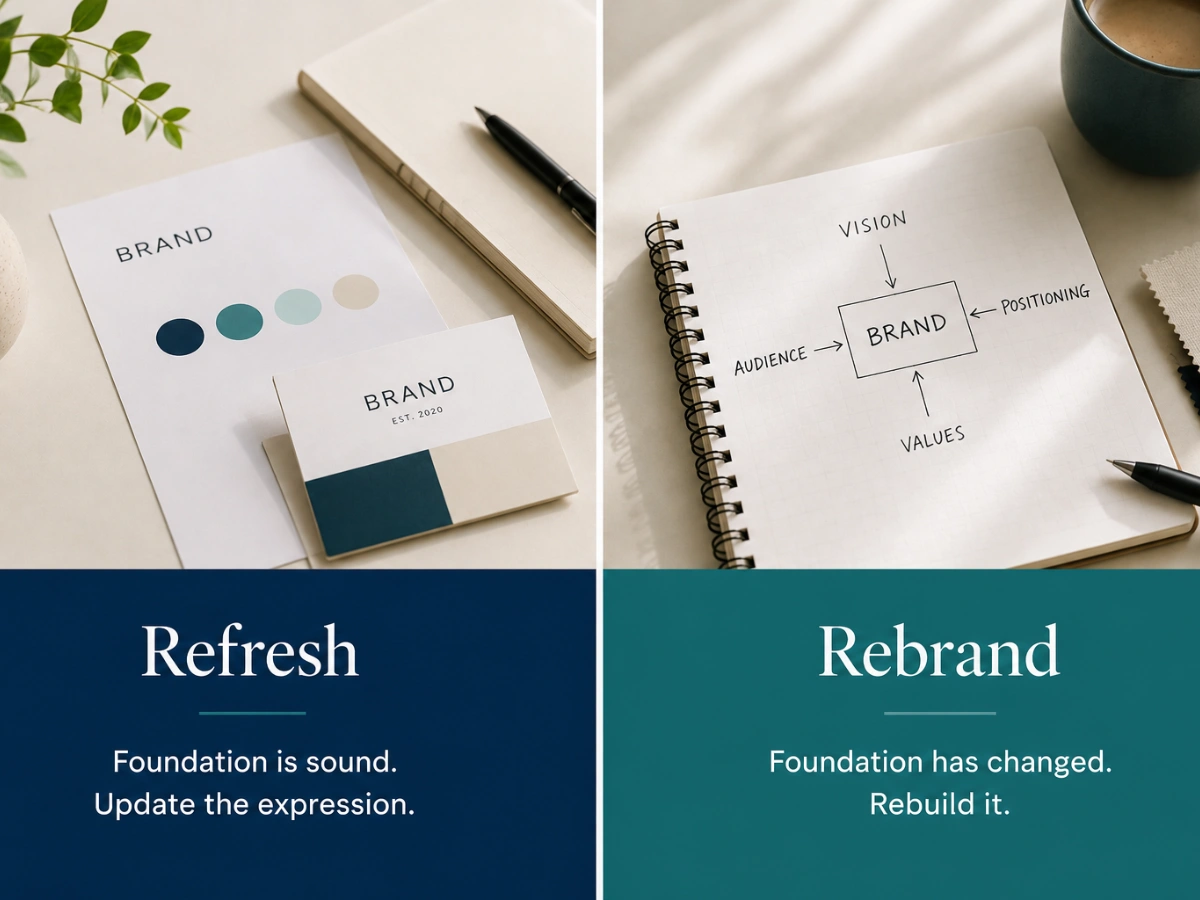
A refresh keeps the core of the business intact: the name, the fundamental positioning, the market recognition that has already been built. What changes is the expression of that positioning. The visual identity gets brought up to current standard. The messaging gets sharpened to reflect what the business has become rather than what it was when it started. The website gets rebuilt around the business as it exists now.
A refresh assumes the strategic foundation is sound. The business knows who it serves and why it matters. What has happened is that the presentation has not kept pace with the substance. The work is to close that gap, not to question whether the foundation itself is right.
This is the more common situation by a meaningful margin. Most businesses that feel their brand needs attention are dealing with a presentation gap rather than a fundamental positioning problem, and a refresh resolves it without the cost, disruption, and risk of starting over.
What a Full Rebrand Actually Involves
A rebrand questions the foundation itself, not just its expression. This is the right scope when the positioning no longer fits the business, the market has shifted in a way that makes the original strategy obsolete, or the business has pivoted into something different enough that the existing brand actively works against it rather than just looking dated.
A rebrand often, though not always, involves a name change. It always involves rebuilding the visual identity from a genuinely new strategic foundation rather than updating the existing one. It is a bigger investment of time, money, and disruption, because it carries real risk: existing market recognition, search rankings, and accumulated trust attached to the old brand do not transfer automatically, and some of it is lost in the transition.
This is the right call considerably less often than business owners initially fear, but it is also the right call often enough that ruling it out without proper consideration is its own mistake.
The Comparison at a Glance
Not sure which one your business actually needs?
Book a free discovery call with Hayley. We can talk through where your business is and help you work out whether this is a refresh or a rebrand situation.
The Question That Actually Decides It

Most decision frameworks for this question focus on symptoms: does the logo feel dated, is the website old, are enquiries down. Those are useful signals but they do not actually answer the refresh-versus-rebrand question, because both a refresh and a rebrand can be triggered by the same symptoms.
The question that actually decides it is this: if you wrote down, honestly and specifically, who your business serves and what makes it different, would that description still be accurate and compelling today? Or has the business itself changed enough that the answer would now be different from what it was when the brand was built?
If the answer to who you serve and why you matter is still accurate, just poorly communicated by the current visual identity and messaging, that is a refresh. The thinking is sound. The expression of it needs to catch up.
If the honest answer to that question has genuinely changed, if the business now serves a different client, solves a different problem, or competes in a different way than it did when the brand was built, that is a rebrand. The thinking itself needs to be redone, not just re-expressed.
What Is the Difference Between a Brand Refresh and a Rebrand?
A brand refresh updates the visual identity, messaging, and website to reflect where a business is now, while keeping the name and core positioning intact. A full rebrand changes the fundamental positioning, often the name, and rebuilds the identity from scratch. A refresh is right when the foundation is sound but has not kept pace with growth. A rebrand is right when the positioning itself no longer fits the business or its market.
How to Get a Reliable Answer, Not a Guess
Answering the core question honestly is harder than it sounds, because business owners are close to their own positioning in a way that makes it genuinely difficult to evaluate objectively. This is exactly the situation a proper brand audit is built to resolve.
A brand audit examines your current visual identity, messaging, website, and client touchpoints against how the business actually operates today, and surfaces the gap precisely rather than relying on instinct. It will tell you, with evidence rather than a feeling, whether the positioning itself is still accurate or whether it has genuinely shifted.
Doing the audit first means the refresh-or-rebrand decision is based on a clear diagnosis rather than a guess made under the pressure of wanting to fix something that feels wrong. It also means whichever option you choose is scoped precisely to what is actually needed, rather than either underinvesting in a real problem or overspending on a manufactured one.
If You Are Still Unsure
When the answer genuinely sits in the middle, and sometimes it does, the more conservative choice is usually the safer one. Starting with a refresh and discovering during that process that deeper positioning work is needed is a much easier correction than committing to a full rebrand and later realising the original foundation was fine all along.
A good refresh process, properly scoped, will surface a genuine positioning problem if one exists. It rarely fails to reveal that the deeper issue needs addressing, because the messaging and strategy work involved in a thorough refresh touches the same fundamental questions a rebrand would, just without the assumption that the answers need to change.
Know exactly what your business needs before you commit the budget.
At WQ Creative, every refresh or rebrand conversation starts with an honest assessment of where your business actually is. Book a free discovery call with Hayley to work out which one is right for you.

.png)