Your Business Grew. Your Brand Didn't.
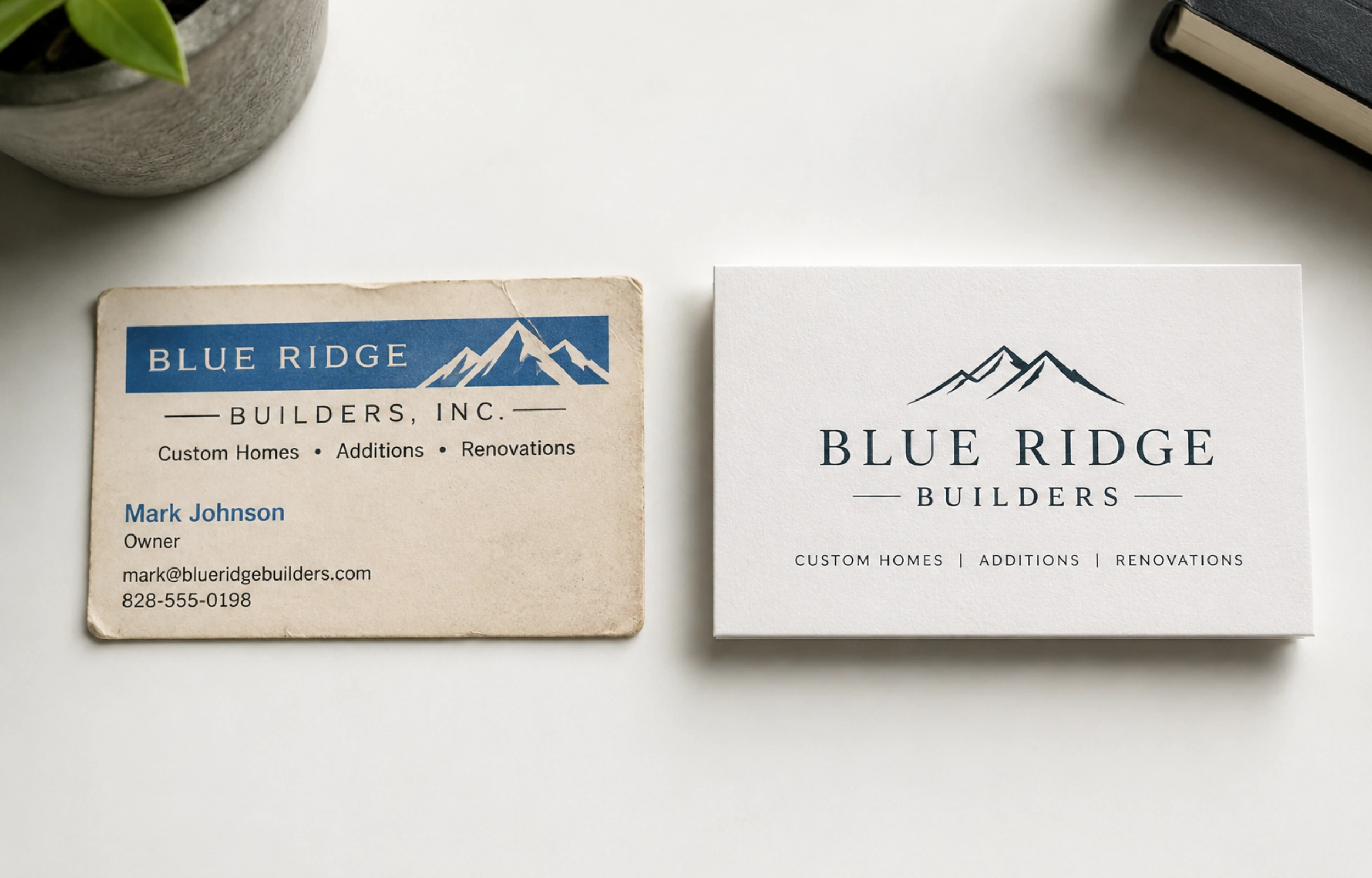
There is a particular kind of discomfort that comes with running a business that has outgrown its brand. It is not failure. It is almost the opposite of failure. The business is doing well. The work is strong. The clients are happy. And yet something feels off every time you send someone your website link or hand over a business card.
You know the brand does not quite reflect where the business is now. It made sense when you started. It might have even been good when you started. But the business has changed, grown, refined its focus, raised its standards, developed a clearer sense of who it serves and what it delivers. And somewhere along the way, the brand stayed behind.
This is one of the most common situations I work with at WQ Creative. Not a brand that was never right, but a brand that was right once and has simply not kept pace. The mismatch is real, the cost is real, and the good news is that addressing it is more straightforward than most business owners expect once they have named the problem clearly.
How the Gap Opens
Brand mismatch does not happen in a dramatic moment. It accumulates slowly, across a series of decisions that each made sense at the time.
The logo was done quickly and cheaply in the early days because there was not the budget for anything else, and getting the business operational mattered more than getting the brand perfect. The website was built when the services were still being figured out and the ideal client was not yet clear. The colours and visual style felt right at a particular stage and then became familiar enough that changing them felt harder than keeping them.
Meanwhile, the business quietly became something different. The offer sharpened. The rates increased. The calibre of client improved. The work got genuinely better. The founder developed a much clearer sense of who they work with best and why. None of that made it onto the brand.
The result is a business that has grown in every meaningful way and a brand that is still introducing it to the world as the earlier, smaller, less certain version of itself.
The Five Ways the Mismatch Costs You
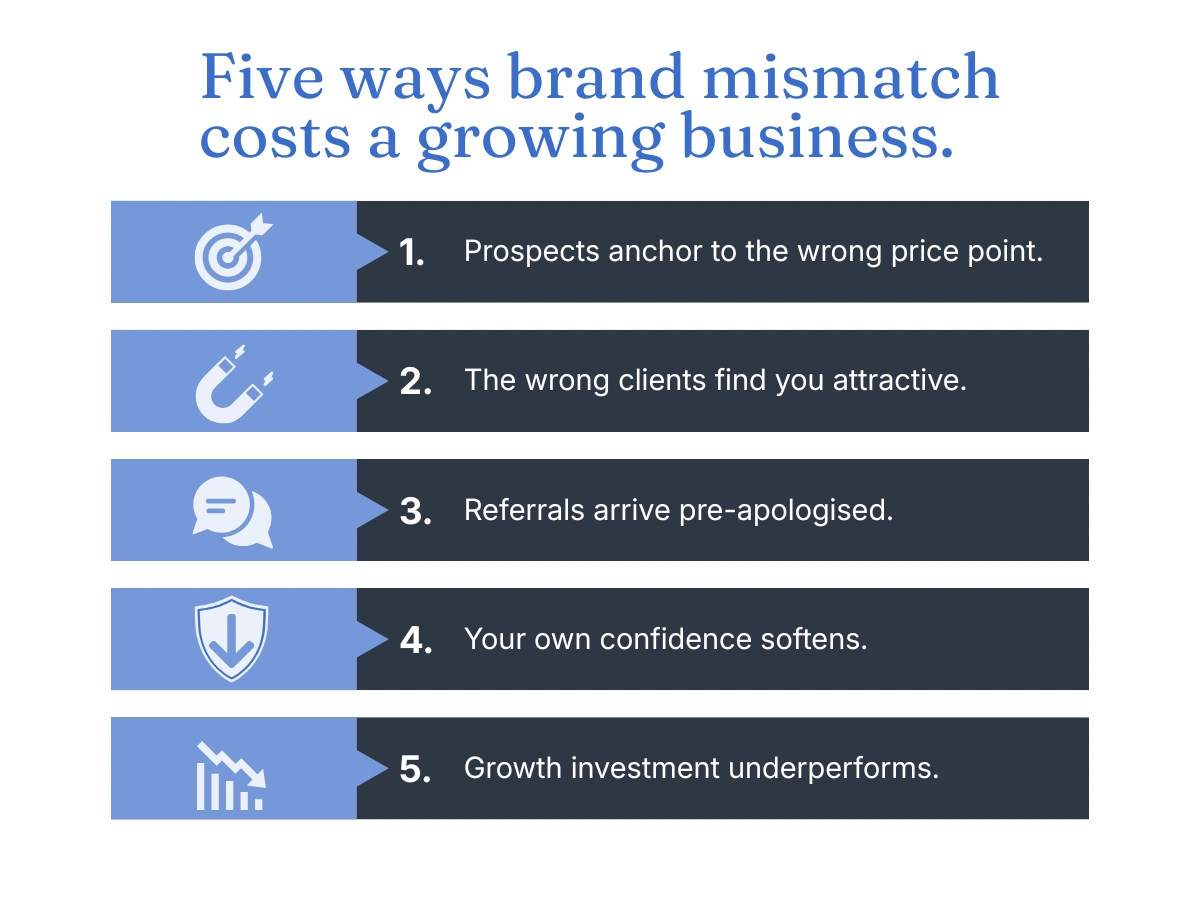
1. Prospects anchor to the wrong price point
Your brand sets a price expectation before you quote a number. A client who visits a website that feels like a small or early-stage business arrives at the pricing conversation expecting small or early-stage rates. When the quote reflects where the business actually is, it feels like a mismatch. Not because the rate is unreasonable, but because the brand has not prepared them for it.
This is one of the quietest and most consistent ways an outdated brand costs money. The rate conversation becomes harder than it should be, and often softer than it should be, because the visual impression has already set the ceiling lower than the work warrants.
2. The wrong clients find you attractive
Your brand is a filter. It signals who this business is for, what level of investment is appropriate, and what kind of working relationship to expect. A brand that reflects where you were three years ago will attract clients from three years ago: clients at the budget level, the complexity level, and the trust level of that earlier stage.
If the clients you are attracting are consistently less aligned, more price-sensitive, or more demanding than the clients you want to work with, the brand is often contributing to that pattern in ways that are easy to miss because the individual interactions feel like individual problems rather than a systemic one.
3. Referrals arrive pre-apologised
When your best clients refer you and feel the need to add a disclaimer about your rates, the brand is doing part of the problem. They know the work is worth it. But they have seen your website and they know your brand does not communicate premium, so they soften the landing in advance. That pre-apology shapes the referred prospect's mindset before any conversation has happened.
4. Your own confidence in your positioning softens
This one is less visible but genuinely consequential. When the brand does not match the business, there is a subtle but persistent friction in every interaction where the brand is visible. Sending a proposal. Sharing the website link. Directing someone to look you up. Each of those moments carries a slight wince — a quiet awareness that what they are about to see does not quite represent what the business actually is.
That friction compounds. It makes it harder to hold your rate firmly, to pitch without hedging, to present with the confidence that the quality of the work actually deserves.
5. Growth investment underperforms
If you invest in marketing, content, SEO, or advertising and those channels point to a brand and website that do not reflect where the business is, the return on that investment will be lower than it should be. Traffic arrives. Visitors look around. The impression does not match the promise. They leave. The investment did its job. The brand did not do its job. The result is wasted spend that gets attributed to the marketing channel rather than the brand problem underneath it.
Recognising this in your own business?
Book a free discovery call with Hayley. We can take a clear-eyed look at where your brand is, where your business actually is, and what closing that gap would look like.
What the Gap Actually Feels Like From the Inside
There is a specific experience that almost every business owner in this situation describes when I talk to them about it. They know the brand is not right. They have known for a while. They have not acted on it because it never quite rises to the top of the priority list, or because the thought of doing it feels larger and more disruptive than the daily friction of living with it.
They describe sending the website link with a caveat. Telling people it is due for an update before they have even looked at it. Wincing slightly when someone asks for the business card. Feeling a quiet relief when a client says they found them through a referral rather than the website, because it means the brand did not have to carry the relationship.
If any of that is familiar, the problem is not imaginary and it is not small. That friction has a real cost, measured in missed opportunities, softened rates, and the accumulated weight of representing your business at a level below what it has actually become.
How Do I Know When My Brand Needs to Catch Up With My Business?
Your brand needs to catch up when there is a visible gap between the quality of your work and the quality of how your business presents itself. The clearest signs are: you hesitate before sending someone your website link, clients express surprise at your rates after seeing your brand, or the clients you are attracting no longer match the clients you want to work with. The brand has stopped growing with the business.
This Is Not About Starting Over
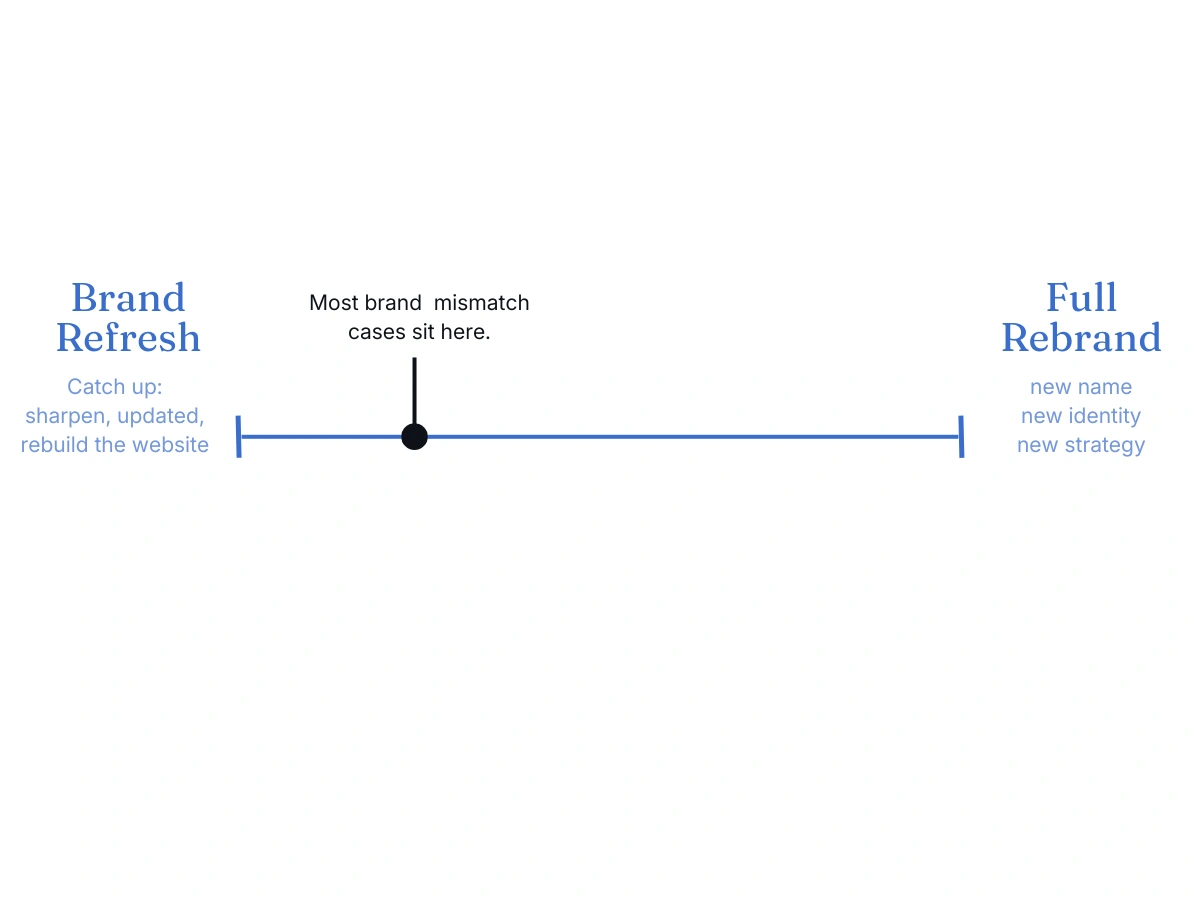
One of the reasons business owners put off addressing brand mismatch is the assumption that fixing it means rebuilding everything from scratch. A full rebrand with a new name, new visual identity, new strategy, months of disruption.
That is sometimes the right answer. More often it is not. Most businesses with this problem have a solid foundation. The positioning is clear, even if it is not well communicated. The ideal client is understood, even if the brand is not speaking to them directly. The offer is strong, even if the visual identity no longer reflects its quality.
What is needed in most cases is not a replacement but a catch-up. Bringing the visual identity up to the standard of the business as it exists today. Sharpening the messaging to reflect what the business has become rather than what it was when it started. Rebuilding the website around the ideal client of now rather than the ideal client of three years ago.
The work involved in that is real. But it is considerably less than most business owners fear, and the return starts immediately. The first time a prospective client visits a site that genuinely reflects the quality of the business behind it, the pricing conversation changes. The referrals arrive differently. The founder sends the link without the caveat.
The brand catches up. And for the first time in a while, the business and its presentation are pointing in the same direction.
Your business has grown. Your brand should show it.
At WQ Creative, we work with service businesses that have outgrown their brand and are ready to build something that accurately reflects where they are now. Book a free discovery call with Hayley.