Branding vs Marketing: What's the Difference and Why the Order Matters

Branding and marketing get used interchangeably in most small business conversations, and that confusion causes a specific and recurring problem: businesses invest in marketing before their branding is clear, wonder why the results are underwhelming, and conclude that marketing does not work for them.
It is not that the marketing did not work. It is that the marketing had nothing solid to amplify. The message was unclear, the positioning was vague, the impression the brand created did not match the expectation the marketing was trying to set. The activity produced noise rather than results.
Understanding what branding and marketing actually are, how they differ, and why one needs to come before the other is one of the more useful things a service business owner can get clear on. This post is my attempt to do that plainly.
What Branding Actually Is
Branding is the set of decisions that determine how your business is perceived. Not just how it looks, though visual identity is part of it. How it is positioned in the market, who it is for, what it stands for, what makes it different, and what impression it consistently creates across every touchpoint where someone encounters it.
A brand exists in the mind of the person experiencing it. It is the answer to the question: when someone thinks of your business, what do they think? What do they feel? What do they expect? Those impressions do not form randomly. They are shaped by every visual, verbal, and experiential signal your business sends, from the first time someone sees your website to the way you open a discovery call.
Strong branding means those impressions are intentional, consistent, and accurate. They reflect what the business actually is and they attract the people the business actually wants to work with. Weak branding means those impressions are formed by default, inconsistent across channels, and often inaccurate in ways that cost the business clients and revenue without the owner quite being able to identify where things are going wrong.
What branding is not
Branding is not a logo. A logo is a single visual element within a brand identity, and brand identity is itself only one component of a complete brand strategy. A business can have a beautiful logo and an underdeveloped brand, and the logo will not compensate for what is missing.
Branding is also not something that can be fully outsourced. A designer can build the visual expression of your brand. But the strategic foundation (who you serve, what you do for them, how you are different, what you stand for) those decisions belong to you. The designer's job is to make that foundation visible. If the foundation is not clear, the design work sits on nothing.
What Marketing Actually Is
Marketing is how you put your brand in front of the people who need to know about it. It is the set of channels, tactics, and campaigns that create awareness, build consideration, and drive the specific actions you want your audience to take.
Marketing includes content strategy, SEO, social media, email, paid advertising, events, podcasts, referral programmes, and any other deliberate effort to grow your reach and generate leads. It is largely tactical, largely measurable, and largely time-bound. A campaign runs, produces results, gets evaluated, and is adjusted or replaced.
What marketing cannot do, on its own, is build trust. It can create familiarity. It can drive traffic. It can prompt action. But the trust that converts a curious visitor into a confident client comes from the brand they encounter when they follow through on the marketing's invitation. If that brand does not hold up under scrutiny, the marketing spend is largely wasted.
The Difference in a Table
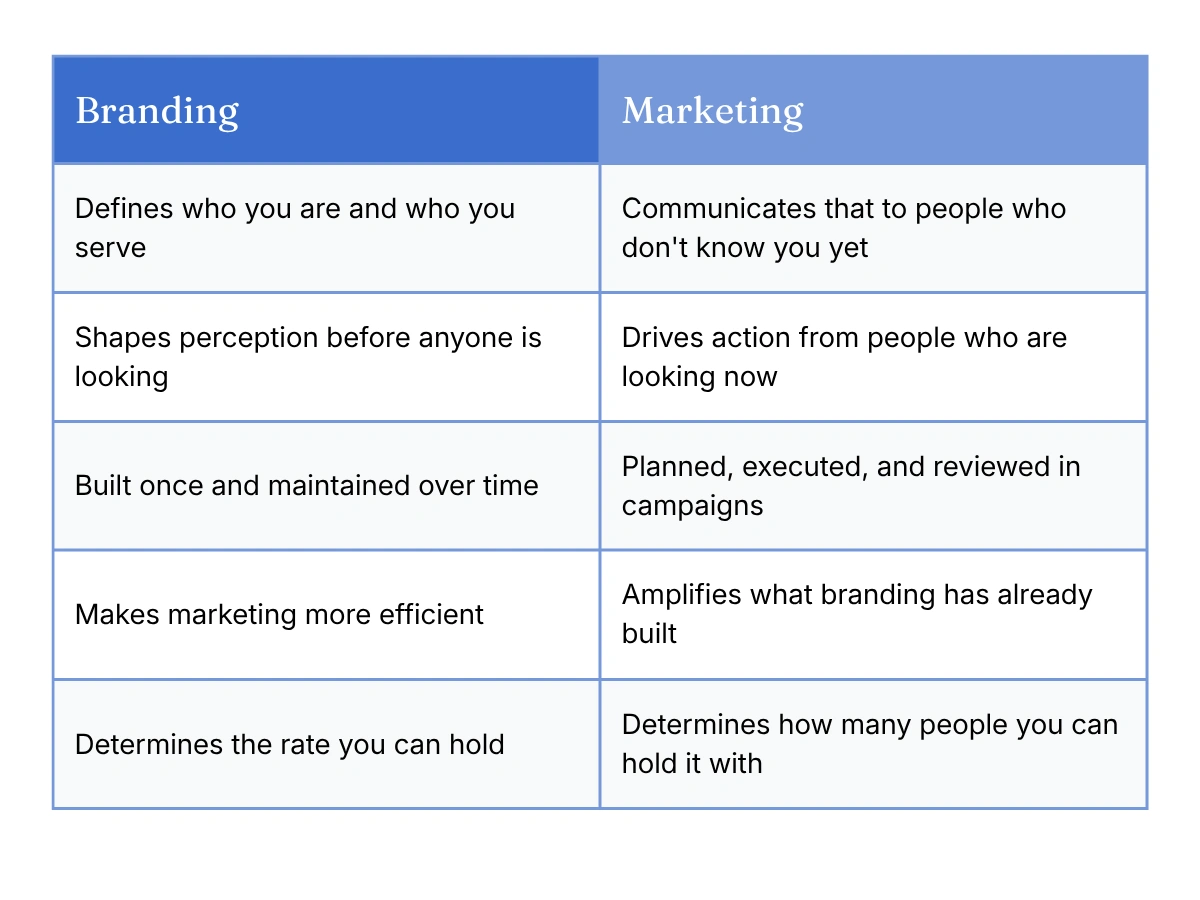
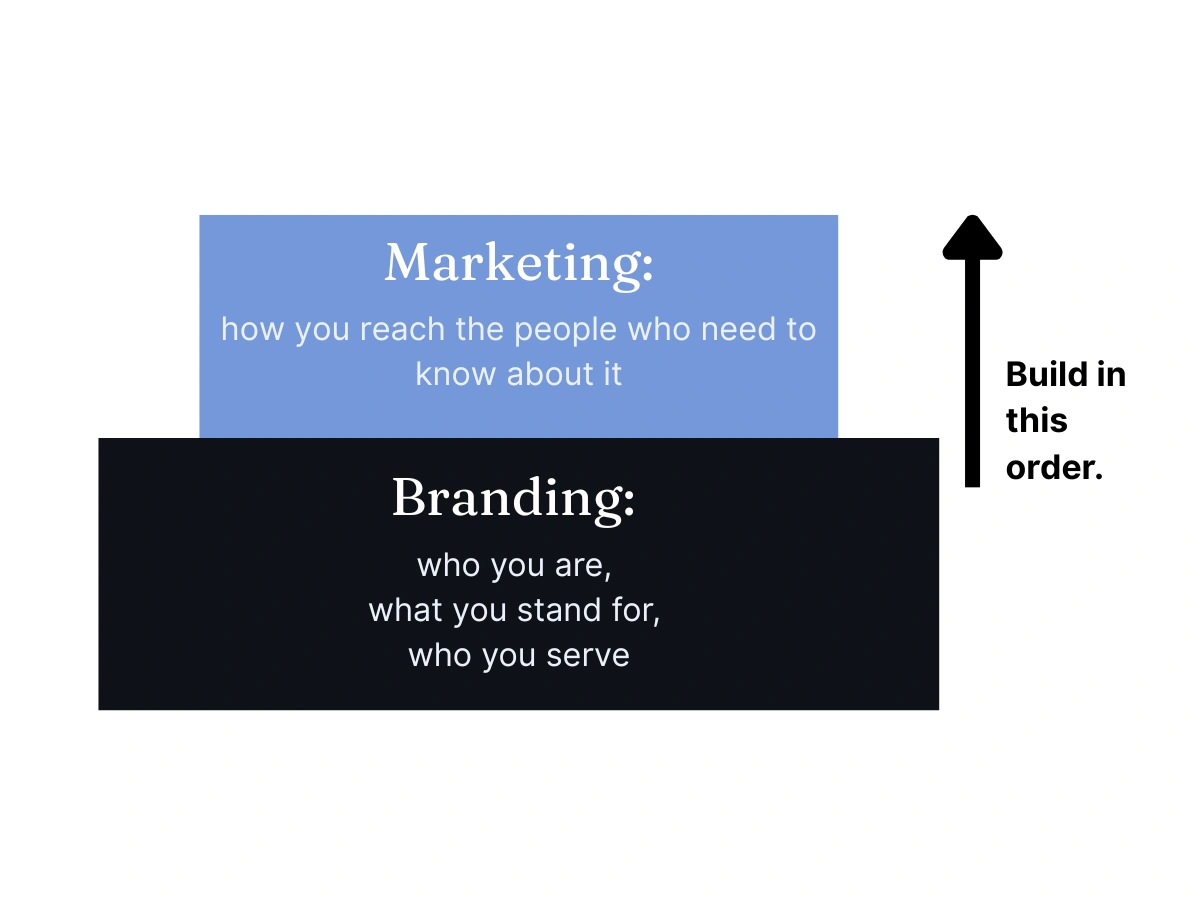
The practical implication of this table is that branding and marketing are not equivalent investments to be balanced against each other. They are sequential. Branding sets the conditions under which marketing performs. Marketing amplifies what branding has built. Getting the order wrong does not just reduce efficiency, it produces the specific experience of spending money on visibility with very little to show for it.
Not sure whether you need to focus on branding or marketing right now?
Book a free discovery call with Hayley. We can work out where your business actually is and what the most useful next move looks like.
Why Marketing Without Branding Underperforms
The pattern I see regularly is a service business that has been operating for a while, is generating most of its revenue through referrals, and decides to invest in marketing to accelerate growth. They start posting consistently on social media, run some ads, commission some content. The activity is real. The results are thin.
The problem is almost never the marketing execution. The problem is that the brand the marketing is pointing to is not doing its job. The website is unclear or outdated. The positioning does not differentiate the business from its competitors. The messaging speaks in generalities rather than to a specific person with a specific problem. When a prospect follows the marketing back to the brand, nothing they find gives them a compelling reason to act.
Marketing is an amplifier. It takes what your brand is already doing and does more of it, faster and to more people. If your brand is already creating a clear, confident, trustworthy impression, marketing accelerates the growth of that impression. If your brand is creating a muddled or underwhelming impression, marketing accelerates that too. More people see it. Fewer of them act.
The one exception
The situation where marketing before branding can make sense is when you are in a very early stage and genuinely testing whether your offer resonates before investing in the full brand build. A simple landing page, a clear offer, and some targeted outreach can tell you a great deal about whether the core idea works before you commit to building a complete brand around it.
The key is that this is a deliberate testing phase with a defined end point, not a permanent operating mode. Once you have validated the offer, the brand work becomes the investment that lets you scale what you have proven.
How to Know Which One You Need Right Now
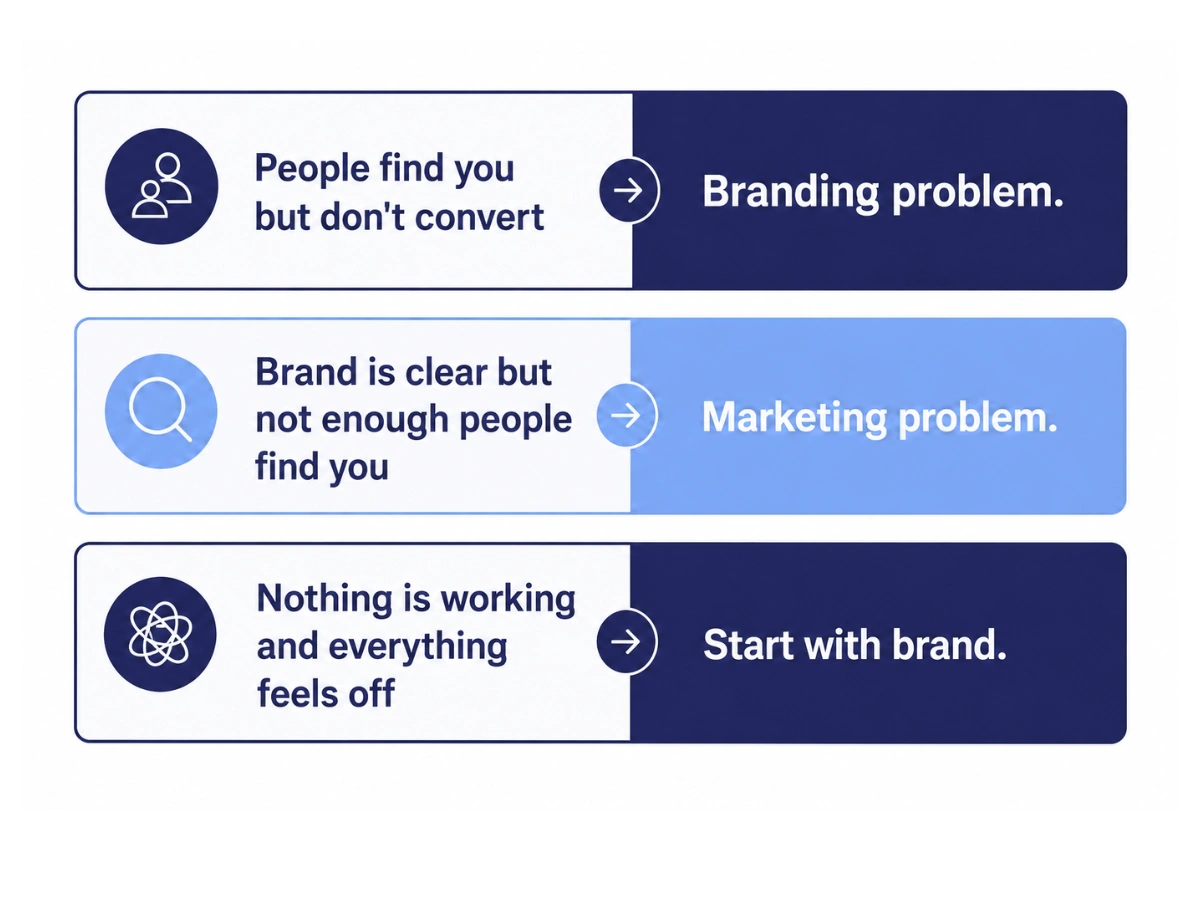
The question worth asking is not 'do I need branding or marketing' but 'what is actually limiting my growth right now.'
If the answer is that people who find you are not converting, that is a branding problem. The marketing is working. The brand is not.
If the answer is that your brand is clear and your website converts but not enough people are finding you, that is a marketing problem. The brand is ready. The reach is not.
If the answer is that you are not sure because nothing is working and everything feels slightly off, start with the brand. In my experience, most businesses in that situation have a clearer offer and more useful positioning than they realise, they just have not found the right way to communicate it yet. Getting that clarity first makes every subsequent investment more effective.
What Is the Difference Between Branding and Marketing?
Branding is what your business is. Marketing is how you tell people about it. Branding shapes the perception, trust, and positioning that determine what rate you can charge and which clients you attract. Marketing amplifies that to a wider audience. The common mistake is investing in marketing before branding is clear, which produces visible activity without the conversion to match.
They Work Together, But Not in the Way Most People Think
The relationship between branding and marketing is not equal weight on two sides of a scale. It is more like a foundation and the structure built on top of it. The foundation has to be there first, and it has to be solid, before the structure is worth building.
That does not mean you have to spend years perfecting your brand before doing any marketing. It means the brand clarity that makes marketing efficient (the clear positioning, the specific ideal client, the consistent visual and verbal identity) should be in place before significant marketing investment begins.
When that sequence is right, the effect is compounding. Branding raises the conversion rate of every marketing effort. Marketing grows the audience exposed to the brand. Each dollar spent on either one produces more because the other is doing its job.
When the sequence is wrong (when marketing investment precedes brand clarity) the spending produces diminishing rather than compounding returns. The activity is visible. The results are not proportionate to the effort. And the business owner ends up concluding that marketing does not work for them, when what is actually true is that the system was built in the wrong order.
Build the foundation first. Then amplify it.
At WQ Creative, brand strategy comes before everything else because without it, everything else costs more and delivers less. Book a free discovery call with Hayley to work out where your business is in that sequence and what to do next.