How a Blog Builds Website Traffic That Actually Converts

Most service business owners know, in a general sense, that blogging is supposed to help with traffic. What is less clear is how, specifically, that happens, and whether the traffic it generates is actually worth having.
Those are reasonable questions. Time spent writing content is time not spent delivering client work or running the business. Before committing to a blog strategy, it is worth understanding exactly what mechanism you are investing in and what you can realistically expect from it.
This post explains how blogging drives website traffic, what makes that traffic valuable, and the one condition that has to be in place for any of it to convert into actual enquiries.
The Traffic Problem Most Service Websites Have
A typical service business website has between five and fifteen pages. A homepage, an about page, a services page or two, a contact page, and maybe a few supporting pages. That is a reasonable structure for presenting what the business does. It is not a particularly effective structure for attracting search traffic.
Google can only rank pages it has indexed. A fifteen-page website gives Google fifteen opportunities to match your site to a search query. Those pages are competing for a small set of keywords, mostly your business name, your service category, and your location. They do very little to capture the wide range of specific questions your ideal clients are typing into search at different stages of their decision-making process.
A blog changes that equation significantly. Each post is an additional indexed page, an additional keyword opportunity, and an additional entry point to your site from search. A service business with fifty well-written blog posts has fifty additional pages working for it in search around the clock, each one potentially ranking for different queries that its core service pages could never capture.
How Blog Traffic Is Generated
Blog traffic from search comes through a mechanism called organic search ranking. When someone types a question into Google, Google returns the pages it considers most relevant and trustworthy for that query. If one of your blog posts is about that specific question and Google considers it a credible answer, your post appears in the results and the searcher clicks through to your site.
The key phrase there is specific question. Generic content (posts about broad topics that hundreds of other websites have covered in roughly the same way) is increasingly difficult to rank for because there is too much competition and too little differentiation. What ranks well, particularly for service businesses, is content that answers a specific question with a specific, experience-led perspective that reflects genuine expertise.
Long-tail search: where service businesses win
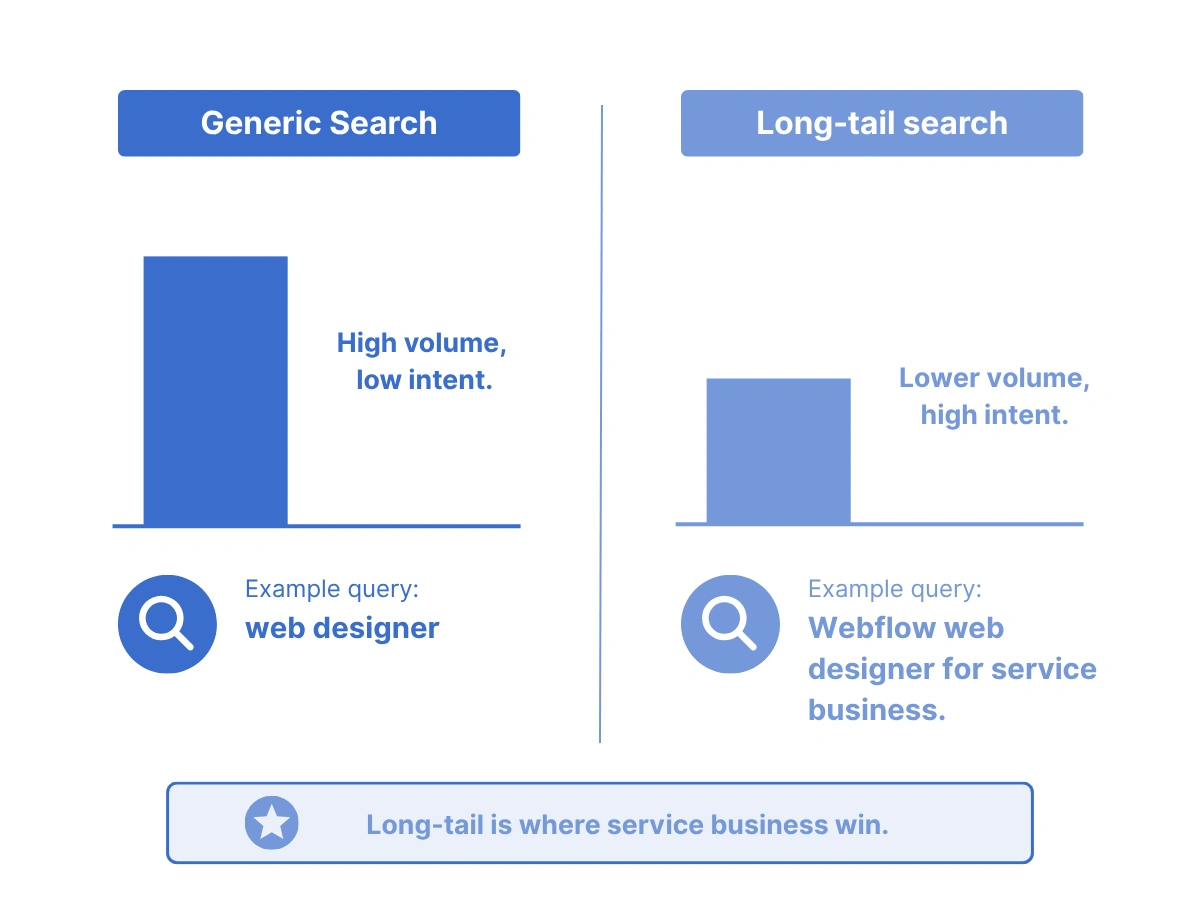
The search queries that drive the most valuable traffic for service businesses are not the high-volume generic terms. They are long-tail queries, longer, more specific phrases that indicate the searcher is further along in their thinking and closer to a decision.
Someone searching 'web designer' is at the beginning of a broad search. Someone searching 'Webflow web designer for service business Cairns' is much closer to booking. Long-tail queries have lower search volume but significantly higher intent, and blog content is the primary way service businesses can rank for them.
A post titled 'What to Look for When Hiring a Web Designer for Your Service Business' will never attract the volume of a generic post about web design. But the people it attracts are the ones actively considering that decision, which is exactly who you want reading your content and visiting your site.
Want a blog strategy built around the questions your ideal clients are actually searching for?
Book a free discovery call with Hayley. Every WQ Creative website project includes SEO structure and content strategy as part of the build.
Why Blog Traffic Is Different From Other Traffic Sources
Not all website traffic is equally valuable. Paid advertising traffic is immediate but expensive and disappears the moment you stop paying. Social media traffic is unpredictable and platform-dependent, algorithm changes or account issues can reduce it significantly overnight. Referral traffic from other websites is useful but largely outside your control.
Blog traffic from organic search is different in three important ways.
It is intent-matched. The person arriving from a search result was actively looking for information related to your service. They were not interrupted by an ad. They found you because they were searching. That makes them significantly more likely to read, engage, and eventually enquire than a visitor who arrived through a passive channel.
It is durable. A blog post that ranks well keeps generating traffic without ongoing spend. A post published today might take three to six months to build meaningful traction in search, but once it is ranking it can continue attracting visitors for years. The investment is front-loaded and the return compounds over time.
It builds domain authority. Every well-performing post strengthens the overall trustworthiness of your site in Google's assessment. That rising authority lifts the ranking potential of your other pages, including your service pages and homepage, even when those pages have not changed. A consistent blog makes the whole site perform better in search over time.
The Compounding Effect Over Time
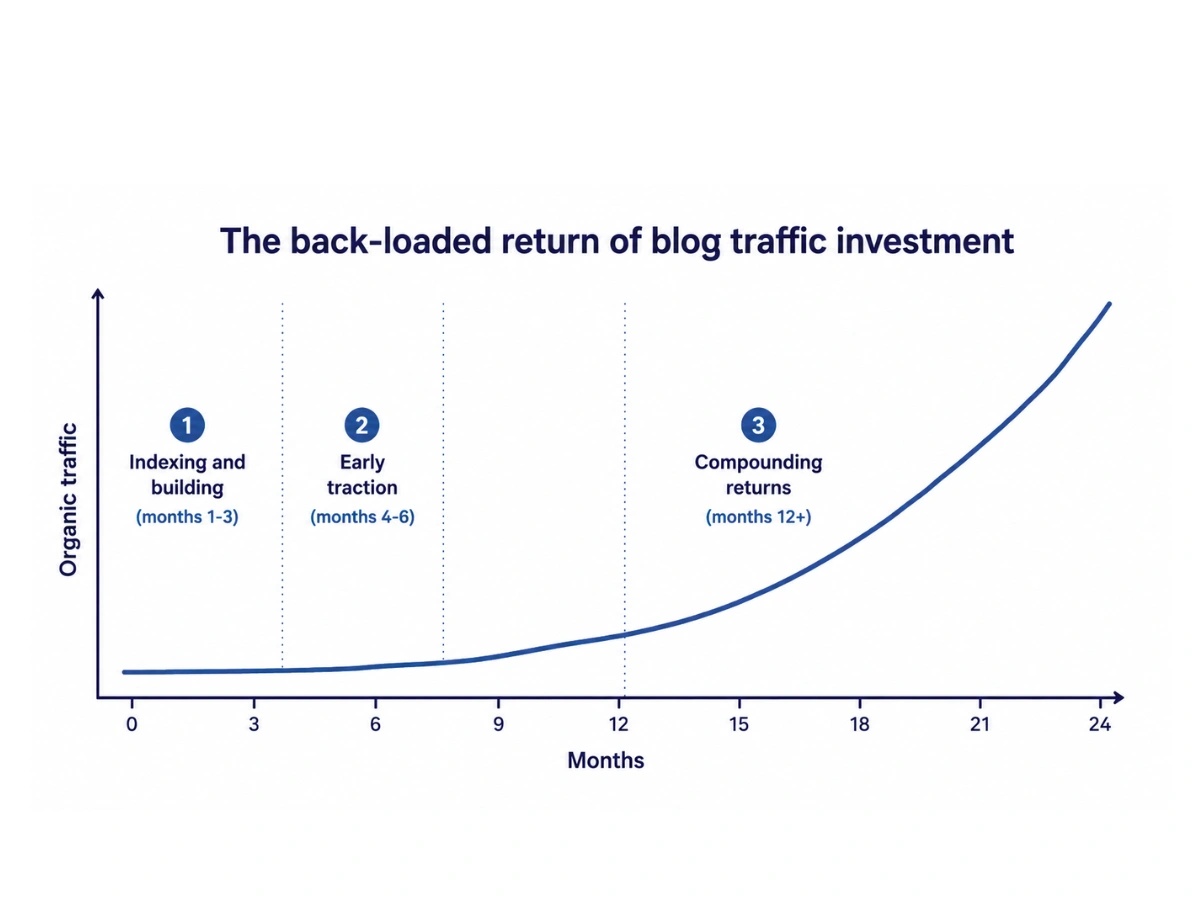
One of the most important things to understand about blog traffic is the timeline. A new post does not immediately attract significant traffic. Google needs time to index it, assess its relevance, and determine where it should rank relative to other content on the same topic. That process typically takes three to six months for a new post on a relatively new site.
This means the return on blogging is back-loaded. The first few months of a consistent blog produce less visible results than the effort put in would suggest. The businesses that abandon their blog strategy at the three-month mark miss the compounding phase that follows.
By twelve months of consistent publishing, a well-structured blog on a service business site will typically have multiple posts ranking and generating traffic, a measurable increase in organic search visits to the site overall, and a portfolio of content that can be repurposed across social media and email. By twenty-four months, the effect compounds further and the blog becomes one of the most cost-effective traffic sources the business has.
What consistent actually means
Consistent does not mean daily or even weekly. For most service businesses, one to two well-researched posts per month is both realistic and effective. The quality of the post matters far more than the frequency, and an irregular schedule of strong posts will consistently outperform a regular schedule of thin ones.
The businesses that see the weakest results from blogging are almost always the ones that published enthusiastically for two months and then stopped. Sporadic bursts of activity do not build the kind of accumulated authority that drives sustained organic traffic. A modest but reliable publishing rhythm over a longer period does.
How Does Blogging Increase Website Traffic?
Blogging increases website traffic by giving search engines more pages to index and more keywords to rank for. Each post is a new entry point to your site from search results. Posts that answer specific questions attract visitors who are actively searching for what you offer. Over time, a consistent blog builds topical authority that raises the ranking potential of your entire site, not just individual posts.
The Condition That Makes Traffic Worth Having
Here is the honest caveat that most posts about blog traffic leave out: traffic is only valuable if the site it arrives at is capable of converting visitors into enquiries.
A blog that drives a hundred new visitors per month to a website that does not clearly communicate who it serves, does not have visible proof, and does not give the visitor an obvious next step will generate very little additional revenue. The traffic did its job. The site did not do its job. The result is the same as having no additional traffic at all.
This is why at WQ Creative the conversation about content strategy always follows the conversation about website strategy, not precede it. Before investing time in building blog traffic, the site that traffic arrives at needs to be ready. The homepage needs to answer the right questions in the first few seconds. The services need to be described in terms of outcomes. The proof needs to be visible and specific. The call to action needs to be clear.
Get the site right first. Then build the blog. In that order, the traffic the blog generates turns into enquiries at a meaningful rate. In the wrong order, you are building an audience for a site that is not ready to receive them.
Traffic to a site that converts. That is the goal.
At WQ Creative, every website build includes the SEO structure and conversion foundations that make blog traffic worth having. Book a free discovery call with Hayley to find out what your current site might be missing.