Local SEO for Australian Service Businesses: What Actually Moves the Needle
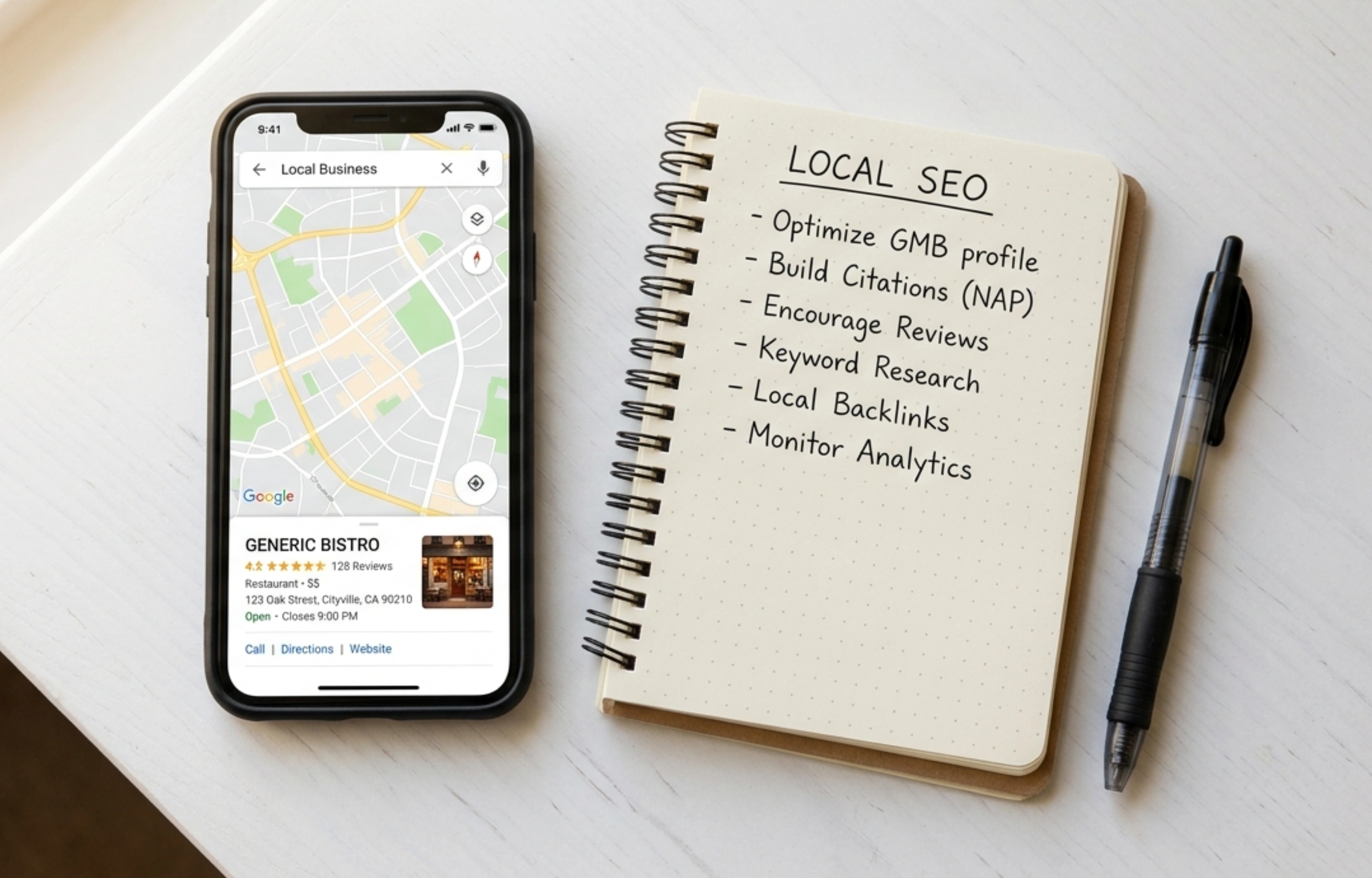
If you run a service business in Australia and you are not showing up in local search results, you are invisible to a significant portion of the people who are actively looking for what you do.
Google holds close to 90 percent of the desktop search market in Australia, and 46 percent of all Google searches have local intent. That means nearly half the people searching are looking for something near them. A consultant, a designer, a physio, a tradesperson, a bookkeeper, if someone in your area is searching for your service and you are not appearing, that enquiry is going to someone else.
Local SEO is the set of actions that tell Google clearly where your business is, who it serves, and why it is a credible answer to those local searches. This post covers the actions that actually produce results for Australian service businesses, in priority order, without the filler advice that fills most guides.
Start With Your Google Business Profile
Your Google Business Profile (GBP) is the single most important asset for local search visibility in Australia. It is what populates the map pack, the three business listings that appear at the top of results when someone searches for a local service, and it is what Google uses to determine whether your business is relevant and trustworthy for a given local query.
If you have not claimed and verified your profile, that is the first thing to do. Go to business.google.com, search for your business, and follow the verification process. Once verified, the profile is yours to manage.
Claiming it is just the start. A verified but incomplete profile will not perform. Google evaluates GBP listings based on relevance, distance, and prominence. You can influence relevance and prominence directly through how you build out the profile.
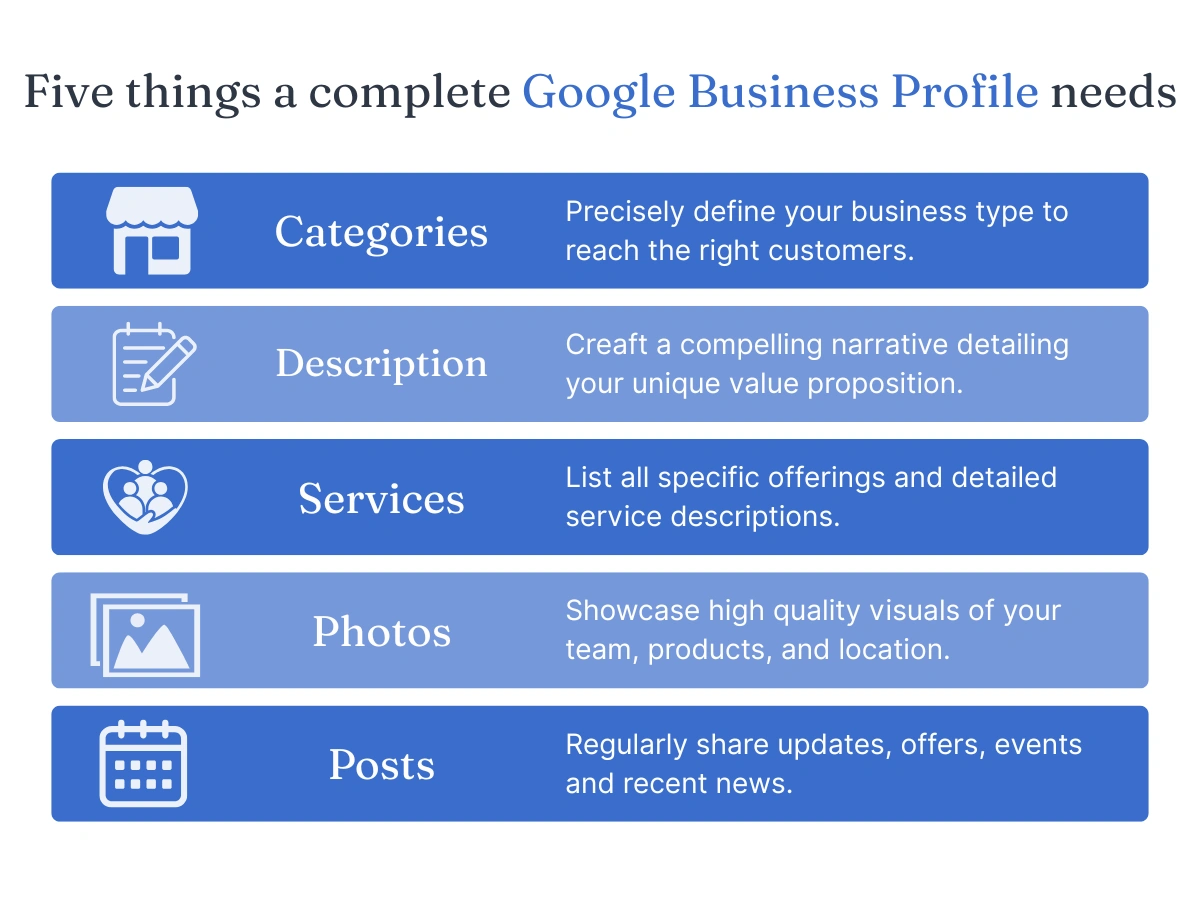
What a complete GBP actually looks like
Business categories: Choose your primary category carefully, it carries more weight than secondary categories. Be specific rather than broad.
Business description: Write a clear, keyword-aware description of what you do and who you serve. Include your suburb or city and the types of clients you work with. This is searchable text.
Services: Add each of your services individually with descriptions. These feed into how Google matches your profile to specific search queries.
Photos: Profiles with photos receive significantly more clicks and direction requests. Add a cover photo, profile logo, and a few images that represent the business and the work.
Posts: GBP posts are short updates that appear on your profile. Publishing one every week or two signals to Google that the profile is active.
Service area businesses
If you operate without a fixed shopfront, which describes most service businesses, you can set your profile as a service area business. This lets you list the suburbs, cities, or regions you serve without displaying a home address publicly.
Be specific about your service areas. Listing all of Australia when you primarily serve Cairns and surrounds tells Google almost nothing useful. The more precisely your service areas reflect where you actually work, the more accurately Google can match your profile to relevant local searches.
Consistency Across Every Directory Listing
NAP consistency, your business name, address, and phone number appearing identically across every platform, is a foundational local SEO signal. Every time Google encounters your business details in a directory, it cross-references them against what it already knows. Consistent information reinforces trust. Inconsistencies create doubt.
For Australian service businesses, the directories worth getting right include Google Business Profile, Apple Maps, Bing Places, True Local, Yellow Pages Australia, Hotfrog, and any industry-specific directories relevant to your sector.
The most common problem is old information left uncorrected after a business changes its phone number, address, or trading name. Run a quick audit by searching your business name and checking the first several results. Any listing with incorrect information should be claimed and updated.
Your website is part of your local SEO. Is it doing its job?
At WQ Creative, every website we build is structured with local SEO in mind from the start. Book a free discovery call with Hayley to find out what your current site might be missing.
Google Reviews: The Trust Signal You Cannot Fake
Reviews are no longer just social proof. In 2026 they are a direct ranking factor, and Google's algorithms, as well as the AI systems increasingly shaping search results, weight them heavily as a signal of real-world trust and legitimacy.
The businesses that consistently appear in the local map pack in competitive Australian markets tend to have a higher volume of reviews, a higher average rating, and more recent review activity than those that do not. Recency matters. A business with 40 reviews from three years ago will generally underperform against one with 20 reviews from the last six months.
How to build reviews without it feeling awkward
The most reliable approach is the simplest one: ask, at the right moment, in a direct way. After a project completes successfully, after a client expresses satisfaction, that is the moment to send a short, direct message with a link to your Google review page.
Do not ask in bulk, do not incentivise reviews, and do not use third-party services that generate artificial reviews. Google has become increasingly effective at detecting review manipulation, and the penalties, including profile suspension, are not worth the short-term boost.
Responding to every review, including negative ones, also signals to Google that the profile is actively managed. A brief thank you on a positive review and a calm, professional response to a negative one is all that is needed.
Location Signals on Your Website
Your Google Business Profile and your website work as a system. Each reinforces the other's local relevance signals. A website that does not clearly communicate where the business is located and who it serves leaves that system half-built.
On-page location signals
Page titles and meta descriptions: Include your suburb or city in the title tag of your homepage and key service pages. 'Brand and Web Design for Service Businesses | Cairns, QLD' tells Google and the searcher where you are and what you do in a single line.
H1 and body copy: Mention your location naturally in the opening sections of key pages. Once or twice in context is enough to establish the signal.
Contact page: Include your full address or service area description, an embedded Google Map if you have a physical location, and your phone number as a clickable link.
Schema markup: LocalBusiness schema is structured data that explicitly tells search engines your business type, location, contact details, and operating hours. Webflow and most modern platforms support this. If your site does not have it, it is worth adding.
Location pages for service area businesses
If you serve multiple suburbs, cities, or regions, individual location pages can help you rank for suburb-level searches that a single homepage cannot capture. A brand designer based in Cairns who also works with clients in Townsville and Mackay could have individual pages for each location, each with genuinely specific content.
The important word is genuinely. Thin location pages that swap out the suburb name and otherwise say the same thing are not useful to the reader and are not rewarded by Google. Each page needs enough specific, relevant content to earn its place.
Local Content as a Long-Term Signal
Beyond the technical foundations, the businesses that build the strongest local search presence over time create content that demonstrates genuine local knowledge and relevance.
For a service business, this might look like a blog post about the particular challenges of rebranding a tourism business in Far North Queensland, or an article about what service businesses in regional Australia need to know before investing in web design. Those posts will not attract thousands of readers. But they will attract the right readers, the ones who recognise their own situation and make contact as a result.
Local content also builds topical authority. Google's E-E-A-T framework, Experience, Expertise, Authority, Trust, rewards content that demonstrates real knowledge of a real context. A service business that consistently publishes experience-led, locally relevant content builds a profile that generic competitors cannot easily replicate.
How Do I Improve My Local SEO as an Australian Service Business?
The highest-impact actions for local SEO in Australia are: claiming and fully completing your Google Business Profile, ensuring your business name, address, and phone number are consistent across every directory listing, collecting genuine Google reviews regularly, and adding location-specific content to your website. For service businesses without a shopfront, defining your service areas clearly in your Google Business Profile is particularly important.
What Local SEO Will Not Fix
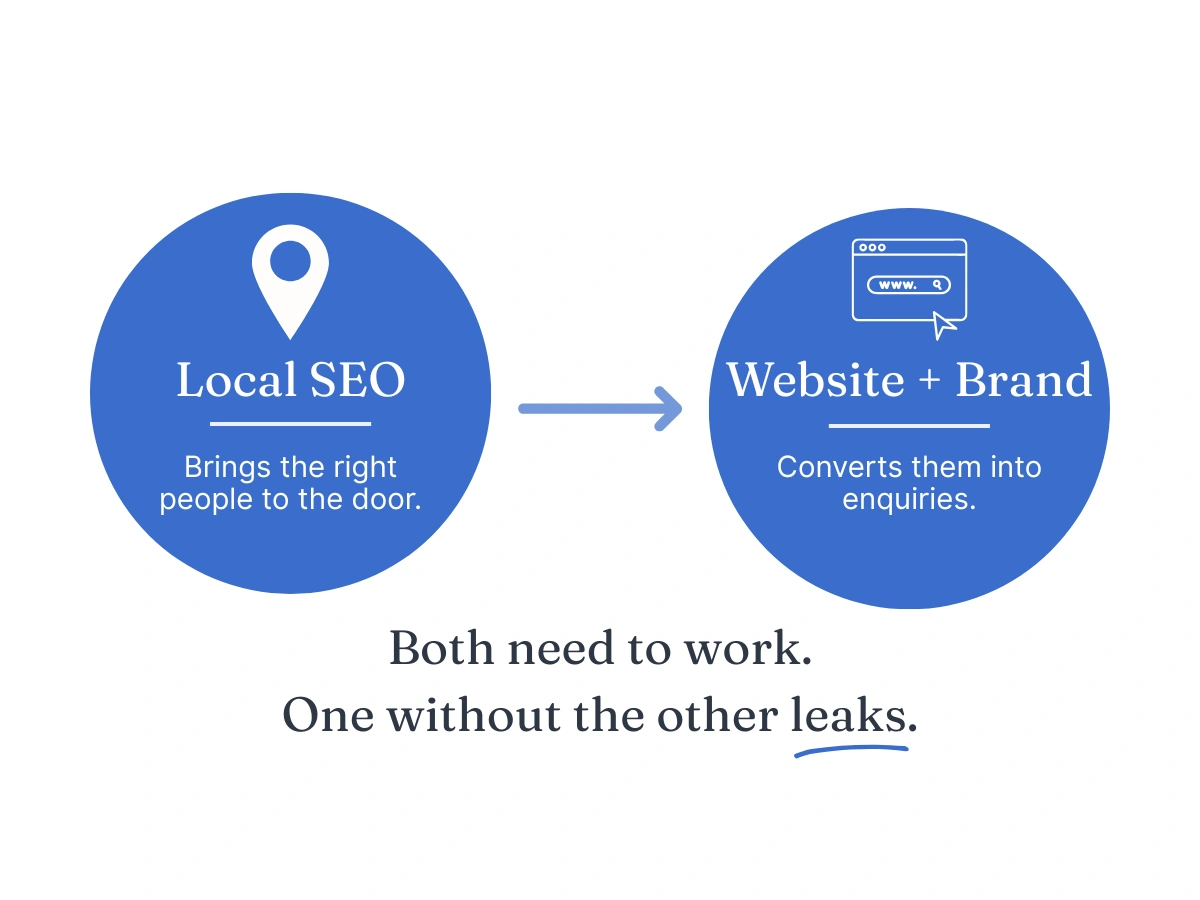
Local SEO is powerful for driving discovery. It gets your business in front of people who are already looking for what you do in your area. What it cannot fix is what happens after they find you.
A well-optimised Google Business Profile that sends people to a website that does not convert is a leaky system. The visibility is there. The conversion infrastructure is not. The enquiry still does not come.
This is why local SEO and website quality are not separate projects. They are two parts of the same system. The local SEO work brings the right people to the door. The website, the brand, and the messaging need to be ready to close the gap between arrival and enquiry.
Before investing heavily in local SEO, make sure the website it points to is worth the traffic. A clear homepage, a services page that describes outcomes, visible proof, and a direct call to action are the minimum. Once those are in place, local SEO investment compounds significantly faster.
A website built for local SEO from the start saves a lot of retrofitting later.
At WQ Creative, every Webflow build includes on-page SEO structure, schema markup, and location signals as standard. If your current site is not pulling its weight in local search, book a free discovery call with Hayley.