How Long Does SEO Take? What Service Businesses Need to Know
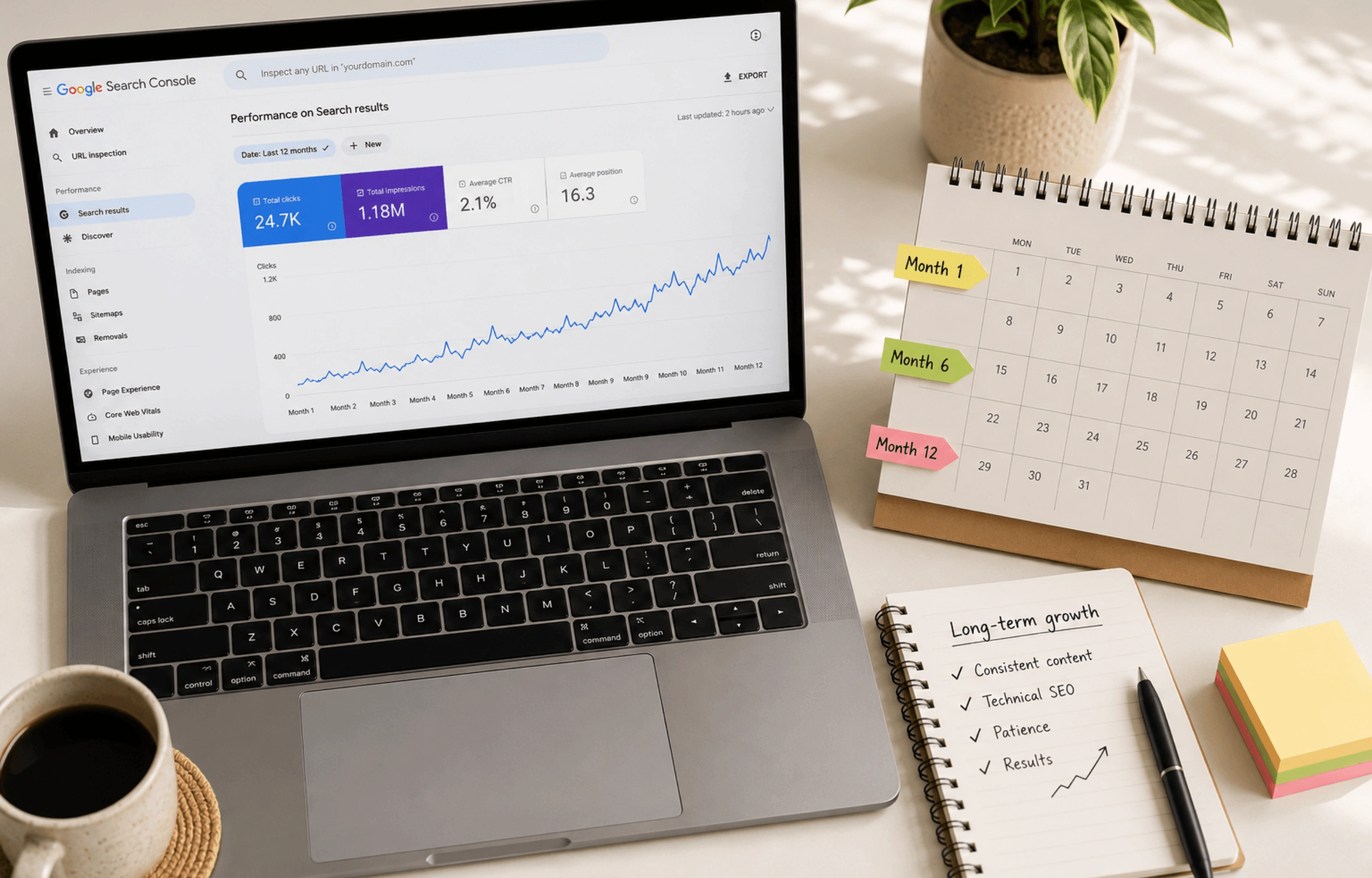
This is the question almost every service business owner asks before committing to an SEO investment. And it is a fair one. If you are going to spend time or money on something, you want to know roughly when you will see a return.
The honest answer is more specific than most guides give you. Not 'it depends' as a brush-off, but an actual account of what happens in the first weeks, the first months, and the first year of serious SEO work. That is what this post is.
It is also an account of why the timeline is what it is, because understanding the mechanism makes it easier to stay the course when results feel slow and harder to be misled by promises of quick rankings that do not materialise.
Why SEO Takes Time: The Mechanism Behind the Wait
Google does not rank pages the moment they appear on the internet. It discovers them, crawls them, assesses them, and then positions them relative to every other page competing for the same search terms. That process takes time, and the time it takes is influenced by how much Google already trusts the site the content lives on.
A new website or a site with limited history gives Google very little to work with. There are few established pages to cross-reference, no track record of useful content, and no external signals from other sites linking to it. Google is essentially meeting the site for the first time and needs to build confidence before awarding meaningful rankings.
An older site with an established content history and some existing rankings has already built that confidence to a degree. New content on an established site tends to rank faster than the same content on a brand-new domain, sometimes significantly faster.
This is not a flaw in the system. It is a quality signal. Google's goal is to return useful, trustworthy results to searchers. Rewarding sites that have demonstrated value over time is part of how it protects that goal.
The Realistic SEO Timeline for a Service Business
Month one: foundations and indexing
The first month of SEO work is almost entirely invisible in terms of traffic results. This is normal and expected.
What is happening behind the scenes: technical issues are being identified and fixed, the site structure is being reviewed for crawlability, Google Search Console is being set up and verified, and the first pieces of keyword-targeted content are being published or optimised.
Google's crawler needs to discover new or updated pages and add them to its index. For a relatively new or low-traffic site, this can take several weeks. A page that has not been indexed cannot rank. Getting that foundation right is what month one is for.
Months two and three: Google starts forming opinions
By month two, Google has typically indexed the new content and is beginning to assess where it should rank. You may start to see some early movement in Google Search Console: impressions rising, a few keywords appearing, some pages beginning to rank on pages two or three of results.
This stage is where most businesses that abandon their SEO strategy do so. The activity is real but the traffic impact is still modest. The temptation is to conclude that it is not working. What is actually happening is that the assessment phase is underway and the results are not yet visible.
Content published in months two and three continues to be evaluated. The more useful, specific, and well-structured it is, the more confidently Google will position it. This period is when content quality has the highest leverage on eventual ranking position.
Months four to six: meaningful ranking and early traffic growth
Month four is typically when SEO results become visible in a way that feels meaningful. Pages are beginning to rank on page one for lower-competition, higher-intent search terms. Organic traffic is increasing. For a service business with well-targeted content, this is when the first enquiries from organic search tend to arrive.
The ranking gains in this period are not uniform. Some content will perform strongly early. Other content will continue climbing slowly. Long-tail keyword posts, which target specific questions with lower competition, tend to rank earliest. Broader, more competitive terms take longer.
By month six, a service business with consistent, well-structured content and a sound technical foundation should have a clear picture of which content is performing, which keywords are within reach, and where additional investment will produce the strongest returns.
Months six to twelve: compounding returns
The compounding phase is what makes SEO different from paid advertising as an investment. A page that ranks well in month six continues to attract traffic in month twelve and month twenty-four, without additional spend. Each well-performing post strengthens the overall authority of the domain, which makes subsequent content rank more easily.
By twelve months of consistent work, a service business website should have a meaningful organic traffic base, multiple pages ranking for relevant terms, and an SEO foundation that is actively supporting inbound enquiries rather than sitting idle.
The businesses that see the strongest twelve-month results are almost always the ones that stayed consistent through the slow months rather than adjusting strategy every time results felt flat.
Your website needs to be conversion-ready before SEO sends traffic to it.
At WQ Creative, every Webflow build includes the SEO structure and conversion foundations that make organic traffic worth having. Book a free discovery call with Hayley.
What Speeds Up an SEO Timeline for Service Businesses
An existing domain with some history
A website that has been live for two or more years and has some existing indexed pages starts with a trust advantage. Google already has a relationship with the domain. New content added to it tends to rank faster than the same content would on a brand-new site.
If you are rebuilding or redesigning your site, preserving your existing URLs where possible is important for exactly this reason. Changing URLs without proper redirects loses whatever ranking equity those pages have built.
Specific, experience-led content targeting long-tail keywords
Generic content on broad topics competes with thousands of other pages and takes a long time to rank, if it ranks at all. Content that answers a specific question, from a specific perspective, for a specific audience has far less competition and ranks significantly faster.
For service businesses, this means writing about the particular situations your ideal clients face rather than the general topics your industry covers. A post about rebranding a trade business in regional Australia will rank faster and attract more relevant traffic than a post about brand design in general.
A technically sound, fast website
Page speed, mobile responsiveness, clean site structure, and proper use of heading tags all influence how efficiently Google can crawl and rank your content. A technically poor website puts a ceiling on SEO performance regardless of content quality.
This is one of the reasons platform choice matters. A Webflow site built with clean code and proper SEO structure gives content a better chance of ranking than the same content on a slow, plugin-heavy site with a disorganised structure.
What Slows an SEO Timeline Down
A brand-new domain with no existing content or authority is starting from zero. It will take longer to build the trust signals Google needs to rank content confidently. This is not a reason to avoid SEO on a new site. It is a reason to start early and stay consistent.
Highly competitive keywords slow results significantly. A service business targeting 'web designer Australia' is competing with thousands of pages from established, high-authority domains. Targeting 'Webflow web designer for service businesses in Cairns' is competing with far fewer pages and will produce results much faster.
Inconsistent publishing is the most controllable variable. A blog that publishes strongly for two months and then goes quiet for three months does not build the signals that consistent publishing does. Modest but reliable output over a sustained period outperforms bursts of activity every time.
How Long Does SEO Take for a Service Business?
Most service businesses start to see meaningful SEO results between three and six months after starting consistent, well-structured work. The first month involves technical setup and indexing. Months two and three see Google beginning to assess and position new content. Meaningful ranking and traffic growth typically appear from month four onward, with compounding returns building through the six to twelve month period. Results vary based on competition, domain age, and content quality.
The Variable That Most People Overlook
Most SEO guides focus on what happens on the way to a ranking. Very few address what happens when the ranking delivers traffic to a site that is not ready to convert it.
Organic traffic from search is more intent-matched than almost any other traffic source. The person arriving found you because they were actively searching for something relevant to what you offer. That is a warm visitor. A site that cannot convert a warm visitor is wasting the single most valuable traffic SEO produces.
Before investing heavily in SEO, the site that traffic arrives at needs to be doing its job. A homepage that answers the right questions quickly, services described in terms of outcomes, proof that is visible and specific, and a clear call to action. Those are not optional extras to add later. They are the conditions under which SEO investment produces a return.
This is why at WQ Creative, website strategy and SEO structure are built together from the start. Not sequentially. Because a site optimised for ranking but not for conversion is a half-built system. And a site optimised for conversion but not discoverable is equally incomplete.
SEO is a long-term asset. Build it on a site that earns the traffic it receives.
At WQ Creative, every website project includes on-page SEO structure, local SEO signals, and conversion foundations as standard. If you want a site that grows in search over time and converts the visitors it attracts, book a free discovery call with Hayley.