How to Know If You're Ready to Hire a Designer or Studio
This is a post I am writing from the designer's side of the table, which means I have a particular view on what makes a design project go well and what makes it fall short. The difference is almost never about the designer's skill or the client's budget. It is almost always about clarity.
Specifically, the clarity the client brings to the project before it starts. What the business actually is. Who it serves. What the outcome needs to achieve. What success looks like twelve months after the new brand or website goes live.
When that clarity is in place, a design project can move quickly, produce something genuinely effective, and deliver a return that justifies the investment. When it is not, even excellent design work ends up solving the wrong problem beautifully. This post is about how to know which situation you are in.
What Readiness Actually Means
Readiness is not about having the money, although budget matters. It is not about having every detail of your business figured out, because that is never fully true for any business at any stage. Readiness is about having enough clarity about the right things to give a designer a brief they can actually work from.
The most common reason a design project underdelivers is not poor execution. It is a brief that shifts during the project because the business owner's understanding of their business changed as they were forced to articulate it. The design process itself surfaced questions that should have been answered before the design work began.
That is not a failure of the designer or the client. It is a sequencing problem. The strategic clarity needed to brief a designer well is the same clarity that brand strategy work is designed to develop. When businesses skip that step and go straight to design, the design project does part of the strategy work and part of the design work simultaneously, which makes both slower and more expensive.
The Signals That You Are Ready
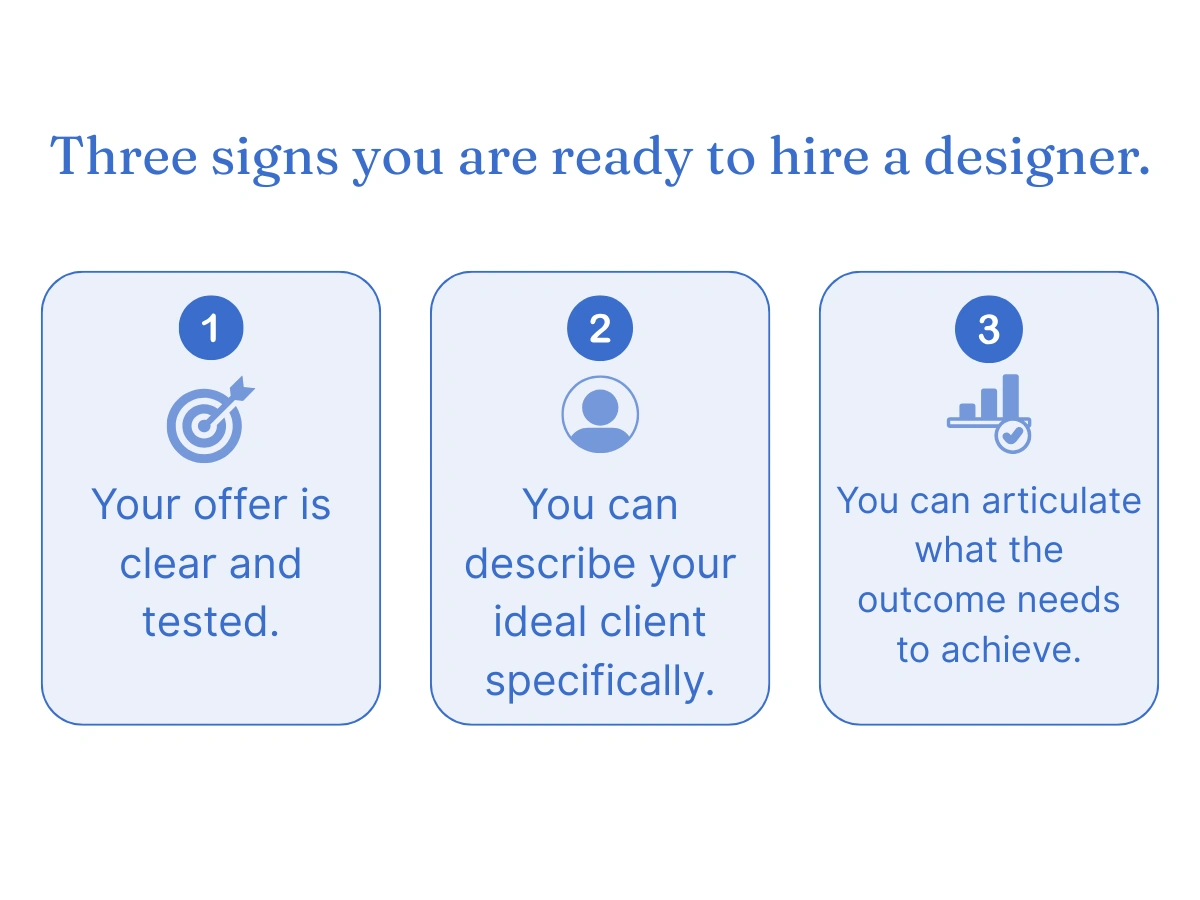
Your offer is clear and you have tested it
If you are still refining what you sell, who it is for, and how it is delivered, you are not ready for a brand or website build. Not because the design cannot be done, but because it will need to be redone when the offer changes. And it will change, because untested offers almost always change once real clients start engaging with them.
The businesses that get the most from a design investment are the ones that have been working with clients long enough to know what their offer actually is in practice, not just in theory. They know which services they most want to be known for. They know which clients they do their best work with. They have a clear enough picture of the business they are building that the brand can be shaped around it rather than built speculatively.
You can describe your ideal client specifically
Not 'small business owners' or 'women in business' or 'purpose-driven entrepreneurs.' A specific person with a specific situation, a specific set of problems, and a specific reason they would choose you over someone else.
This matters enormously for design because every decision, from the words on the homepage to the visual tone to the way services are structured on the page, is made in reference to that specific person. A designer working without a clear ideal client profile is guessing at what will resonate. A designer working with a precise, well-understood client profile can make every decision deliberately.
If you find it genuinely difficult to describe your ideal client with specificity, that is a signal to do the strategic work first. The design will follow more naturally once that foundation is in place.
You can articulate what the outcome needs to achieve
There is a difference between wanting a new brand because the current one feels dated and wanting a new brand because you need to attract a more premium client, hold a higher rate, and build a pipeline that is not dependent on referrals. Both are valid reasons. But the second gives a designer a measurable target to work toward, and that changes both the brief and the outcome.
Before reaching out to a designer, it is worth getting specific about what success looks like. Not just 'it looks more professional' but what changes in the business when it does. What types of clients start enquiring? What happens to the price conversation? What does the referral quality look like? Those specifics become the brief, and a good brief produces better work than a vague one.
Not sure whether you have enough clarity to start a design project yet?
Book a free discovery call with Hayley. That conversation is designed to work out exactly where you are and what would make the most sense as a next step.
The Signals That You Are Not Quite Ready
You want the design to do the strategic thinking
This is the most common version of not-quite-ready, and it is worth naming directly because it is an easy trap to fall into. The business has been operating for a while but has not fully resolved questions about positioning and ideal client. The thinking is that a new brand or website will force those decisions to be made.
It will. But it will make them in the context of a design project that is already in motion, under time pressure, with the designer waiting for direction. That is not the right environment for strategic thinking. It produces rushed decisions that get locked into design that then needs to be revisited.
If you are not yet clear on the strategic questions, the most valuable investment is not a design project. It is the strategy work that comes before one. At WQ Creative, brand strategy is always the starting point for that reason. The design follows from the strategy rather than trying to do both jobs at once.
Your schedule cannot support the collaboration
A good design project requires real engagement from the client. Not constant availability, but genuine attention at the moments that matter: reviewing concepts, giving considered feedback, making decisions about direction. A client who is too stretched to engage properly will slow the project, frustrate both parties, and often end up with an outcome that reflects the path of least resistance rather than the best decision.
If the next four to eight weeks are genuinely impossible to carve time from, it is worth waiting. A slightly later start with proper engagement will produce a better outcome than an earlier start with distracted participation.
The budget is built around visuals only
Design without strategy produces things that look good but may not work. A logo without brand strategy is decoration. A website without conversion thinking is a brochure. If the budget is sized only for the visual execution and not for the strategic foundation, the deliverables will be weaker than they should be for what is being paid.
This does not mean every design project needs to be expensive. But the budget should reflect what the project actually requires to do its job properly. A conversation with a designer before scoping the project will usually clarify what that looks like for your specific situation.
How Do I Know If I'm Ready to Hire a Brand Designer or Studio?
You are ready to hire a brand designer or studio when your offer is clear and tested, you understand who your ideal client is, and you can articulate what you want the outcome to achieve. Budget and timing matter, but the most important readiness factor is clarity: a designer can make your business look right, but only you can tell them what right means for your specific situation.
What to Have in Place Before You Reach Out
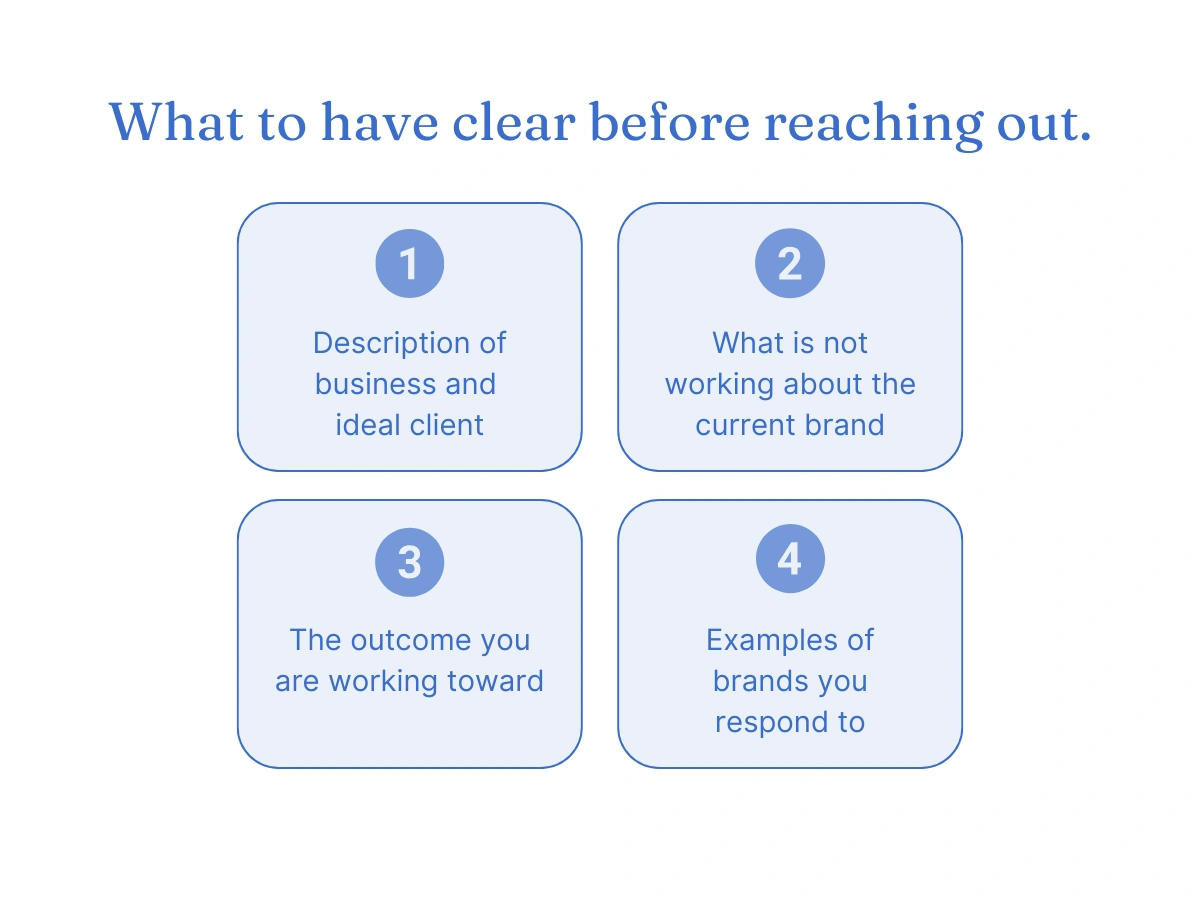
If the readiness signals are there and you are considering reaching out to a designer or studio, these are the things worth having clear before the first conversation.
A clear description of your business, your offer, and your ideal client. Not a polished version, a working version. Who you serve, what you do for them, and what makes the working relationship go well.
An honest view of what is not working about the current brand or website. The more specific this is, the more useful it is as a brief. 'It feels outdated' is a starting point. 'The homepage does not communicate that we work with premium clients and our conversion rate reflects that' is a brief.
A sense of the outcome you are working toward. What does the business look like twelve months after the new brand or website is live? What has changed? What types of clients are enquiring? What is different about the rate conversations?
Some examples of brands or websites you respond to. Not because the designer will replicate them, but because they are a useful shorthand for the visual and tonal territory you are drawn to. Three or four examples with a sentence about what you like about each is genuinely helpful as a starting point.
None of these need to be fully resolved before the first conversation. A good discovery call will help clarify what is still ambiguous. But having thought about them will make that conversation more productive and give both parties a clearer sense of whether the fit is right.
If you are reading this and thinking 'that sounds like me,' it probably is.
The discovery call at WQ Creative is a genuine conversation about where your business is and whether a design project is the right next move. No obligation and no sales pressure. If you are not ready, Hayley will tell you that and point you toward what would be more useful.