Why Purpose-Led Businesses Struggle to Market Themselves (And How to Fix It)

There is a particular kind of business owner who does excellent work, cares deeply about their clients, and finds marketing almost physically uncomfortable.
They are not lazy. They are not unconfident in their work. They are often the most skilled and most conscientious people in their field. But when it comes to putting themselves forward, talking about what they do, or making a case for why someone should choose them over someone else, something stops.
It usually gets labelled as a confidence problem or a visibility problem. I think it is something more specific than that, and understanding it precisely is the first step toward fixing it.
Where the Discomfort Actually Comes From
Most purpose-led business owners are uncomfortable with conventional marketing because conventional marketing asks them to do things that feel misaligned with the values that drive their work.
Conventional marketing is built around claims. You are the best. You are different. Your results are exceptional. It uses urgency, scarcity, social comparison, and aspirational language to move people from consideration to action. For a certain type of business and a certain type of personality, this is not a problem. They are comfortable making claims and comfortable with the persuasion mechanics.
For a purpose-led business owner, most of those mechanics feel dishonest. Not because their work is not genuinely good, but because exaggeration and manipulation are incompatible with the way they operate with clients. The same care and integrity that makes their work excellent makes it impossible to market in a way that feels like a performance.
The problem is not marketing itself. It is that the most visible models of marketing are built for a different kind of business and a different kind of person.
The fix is not to override the discomfort and do the marketing anyway. It is to find a form of marketing that is actually aligned with how this type of business operates. And that requires a different starting point.
The Specific Traps Purpose-Led Businesses Fall Into
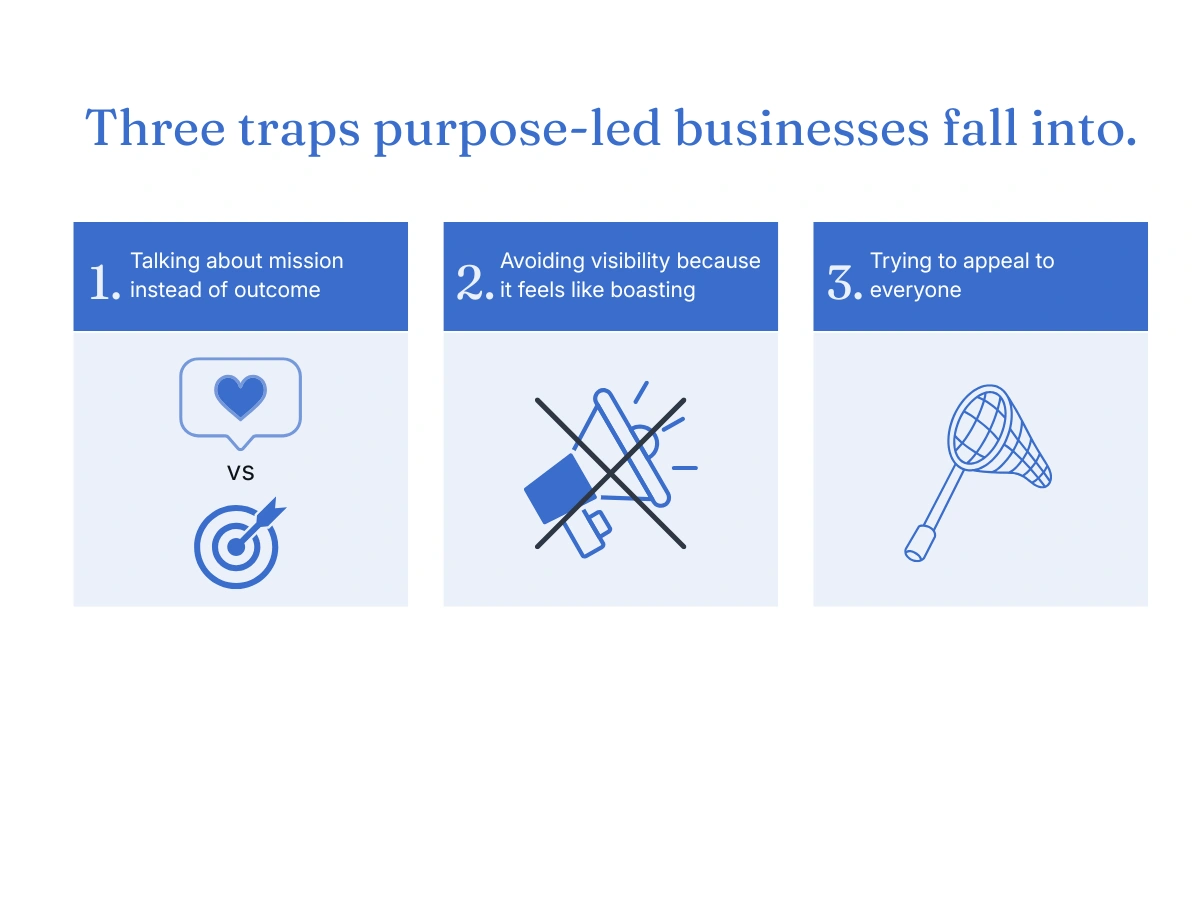
Talking about the mission instead of the outcome
Purpose-led businesses tend to communicate at the mission level. They lead with what they believe, what they stand for, and why they do the work. This is natural, the mission is what drives them, but it is rarely what the client is primarily searching for.
A prospective client is not looking for a business that shares their values, at least not first. They are looking for a business that can solve their specific problem. Values alignment matters and will become a reason they choose you over someone else with equivalent skill. But it cannot be the lead. The lead has to be the outcome the client gets, stated clearly and specifically.
The most effective version of this kind of marketing talks about outcomes first, lets the values become visible through the specificity and care of the communication, and trusts the reader to recognise the alignment without being told about it directly. Show, do not declare.
Avoiding visibility because it feels like boasting
Many purpose-led business owners hold back from sharing their work, their results, and their perspective because talking about what they have achieved feels like self-promotion in the uncomfortable sense. The result is a business that is excellent and largely invisible to anyone outside its existing network.
The reframe that tends to help here is thinking about marketing not as promotion but as evidence. A case study is not a boast. It is documentation of what changed for a real client in a real situation. A piece of content that shares a specific perspective on a problem your ideal client faces is not self-aggrandisement. It is a signal that you understand their situation and have thought carefully about it.
The people who most need to find you cannot do that if you are not visible. Staying quiet in the name of humility is not serving them. It is leaving them to find a less careful, less committed provider because you were not willing to show up.
Trying to appeal to everyone because they care about everyone
Purpose-led businesses often find it genuinely difficult to narrow their ideal client because they want to help broadly. The mission feels universal. The work could benefit many different types of clients. Choosing a specific audience feels like excluding people who need what they offer.
But marketing that tries to speak to everyone speaks clearly to no one. The more specific the description of the client and the situation, the more strongly the right person recognises themselves in it. A prospect who reads a piece of content and thinks 'that is exactly my situation' is already partway to trusting the business before they have made any contact. That moment of recognition cannot happen if the communication is too broad to create it.
Specificity is not exclusion. It is clarity. A narrowly focused message reaches the right person more reliably than a broadly focused one, and the right person is the one the business can actually serve well.
Recognising this in your own business?
Book a free discovery call with Hayley. At WQ Creative we work specifically with purpose-led service businesses to build the brand and communication strategy that makes marketing feel like sharing evidence rather than making claims.
What Marketing Actually Looks Like for This Kind of Business
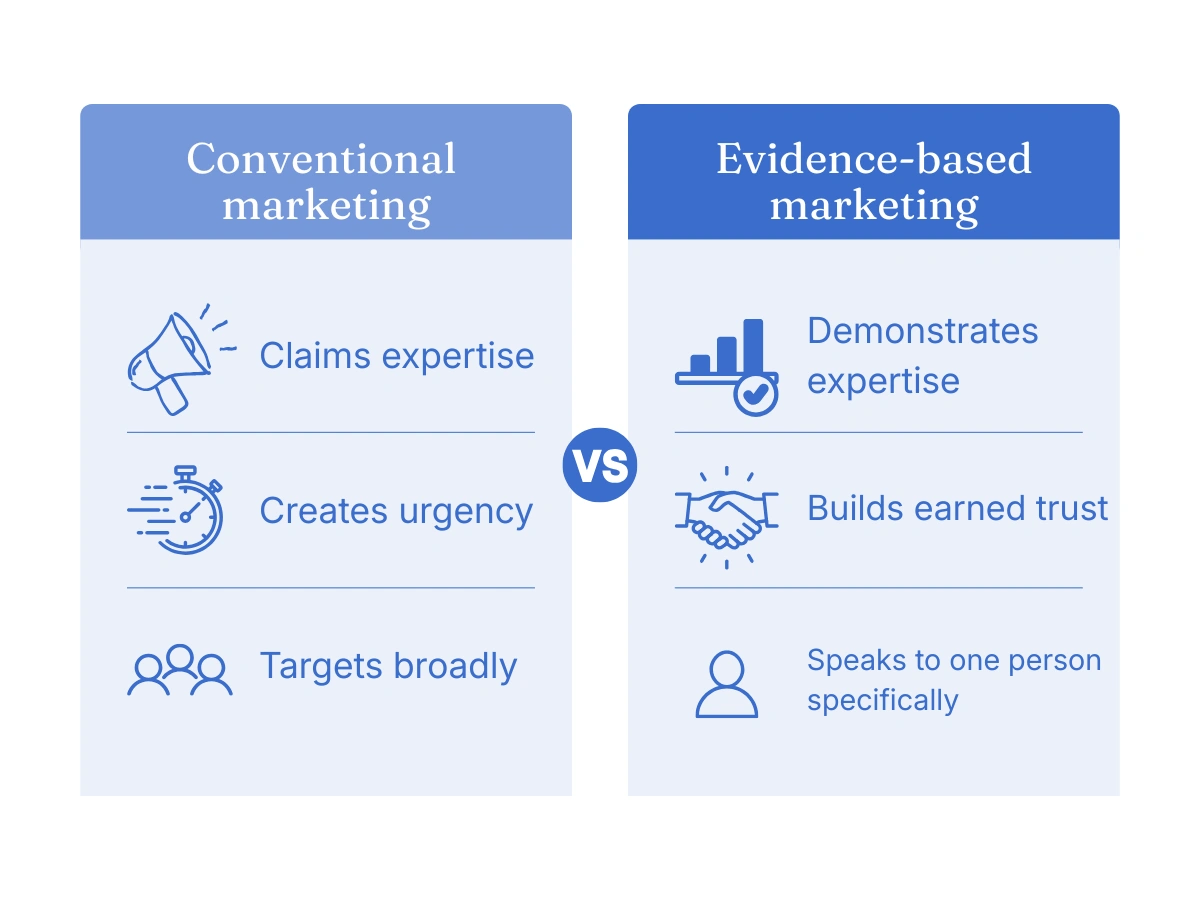
The type of marketing that works for purpose-led businesses is not the high-volume, high-persuasion approach that dominates most marketing advice. It is quieter, more specific, and more durable.
It is built around demonstrating genuine expertise rather than claiming it. Around specific, outcome-focused case studies that let the client see themselves in the situation. Around content that shares real perspective on the problems the ideal client faces, written in the language they use to describe those problems themselves. Around a brand and website that communicate quality and care before a word is exchanged.
This is marketing as earned trust rather than manufactured urgency. It takes longer to build than a campaign built on scarcity and social proof. But the clients it attracts are exactly the right ones, the ones who chose the business because they read something, saw something, or found something that made them confident before they ever picked up the phone.
The brand does the work that marketing amplifies
For purpose-led businesses especially, the brand foundation is not optional infrastructure. It is the thing that makes every piece of marketing work harder.
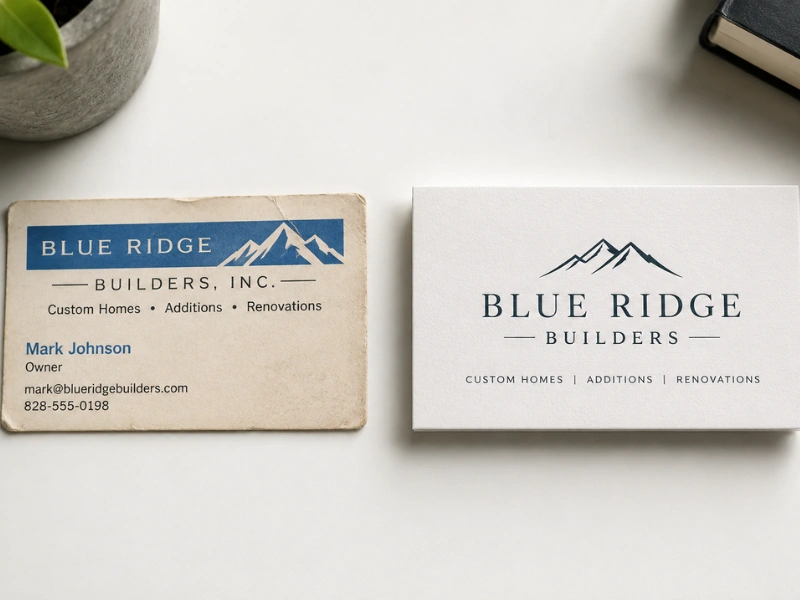
A clear brand communicates the values without having to state them. The specificity of the positioning, the language of the copy, the quality of the visual identity, the way case studies are written, all of these carry the purpose without requiring the business owner to lead every piece of content with a values declaration.
When the brand is built around a clear ideal client, a specific outcome, and a genuine point of view, marketing becomes a matter of sharing evidence that the brand is what it says it is. That is a form of marketing most purpose-led business owners can engage with comfortably. It does not require them to be someone they are not. It requires them to be more precisely, more visibly, more clearly what they already are.
Why Do Purpose-Led Businesses Find Marketing So Difficult?
Purpose-led businesses struggle to market themselves because the skills that make them excellent at their work (deep care for the people they serve, genuine commitment to doing things well, discomfort with exaggeration) are the same qualities that make self-promotion feel wrong. The fix is not to become a different kind of marketer. It is to build a brand and communication strategy specific enough that marketing feels like sharing evidence rather than making claims.
A Practical Starting Point
If this resonates and you want a concrete next step, the most useful thing is to document what actually changed for three of your best clients. Not in a polished way. Just the situation before, what the work involved, and what was measurably different after.
Read those three accounts back. Notice the language your clients use to describe their situation, the problem, and the outcome. That language is your marketing copy. It is specific, it is honest, it reflects real outcomes, and it is written entirely in terms of what the client experiences rather than what the business does.
That is not boasting. It is evidence. And it is the foundation of marketing that a purpose-led business can do with integrity, because it does not require exaggeration, manipulation, or any distance from the values that drive the work in the first place.
Your work is worth being found. Build the brand that makes finding it possible.
At WQ Creative, we work with purpose-driven service businesses to build brands and websites that communicate their value clearly and specifically, without requiring them to compromise the integrity of their work to do it. Book a free discovery call with Hayley.

.png)