How to Write Website Copy That Actually Converts
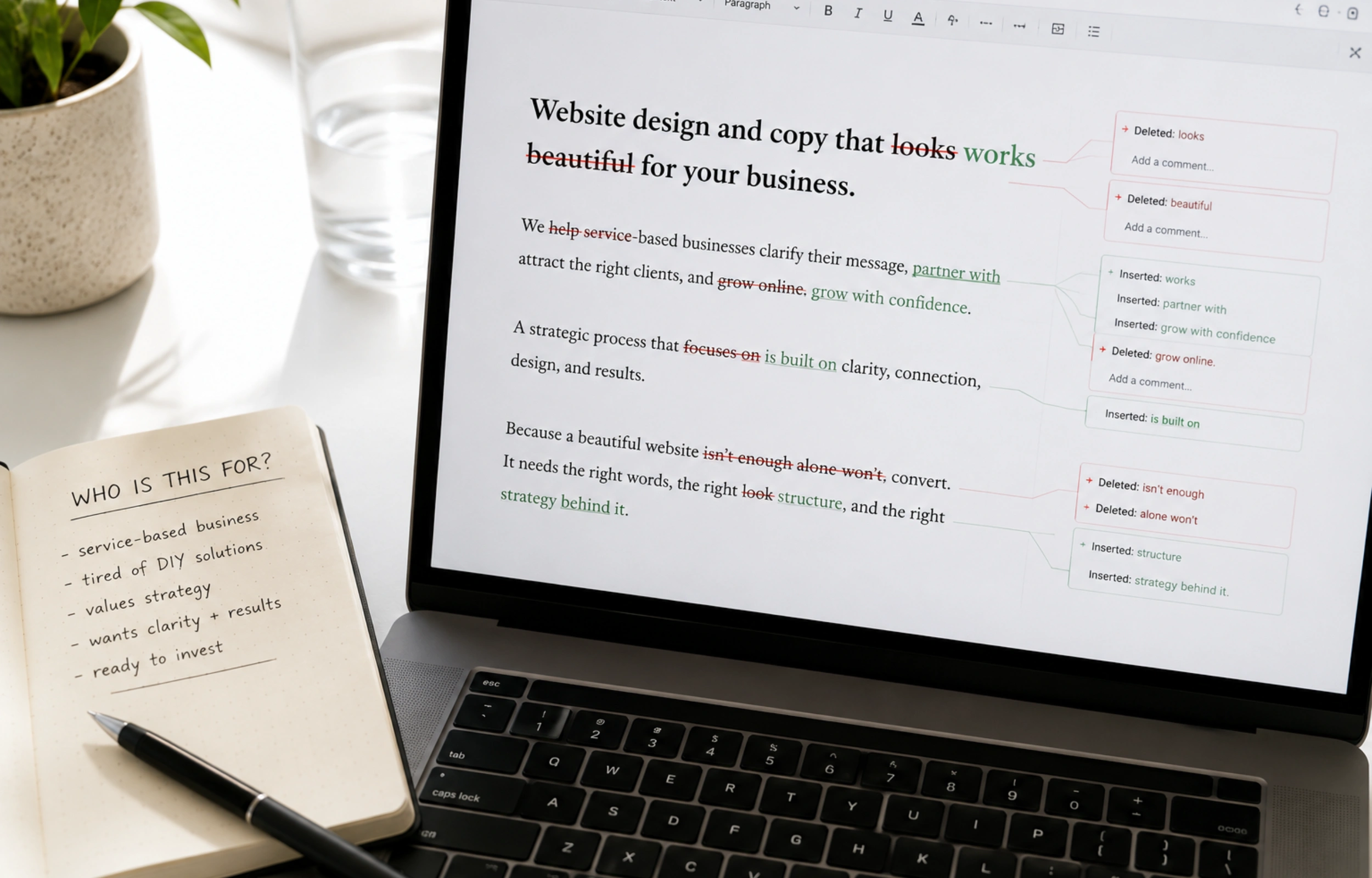
Most service business owners can write. The problem is rarely grammar or vocabulary. The problem is that website copy is a different skill from the writing most people are good at, and almost nobody is taught how to do it.
Good website copy is not clever, comprehensive, or even particularly creative. It is specific. It speaks to one person, in one moment, about one outcome. That sounds simple. In practice it is the single hardest thing to get right, because the instinct when writing about your own business is to cover everything it does for everyone it might help.
This post is a practical guide to writing copy that actually converts, built around the principle that clarity beats cleverness every time.
Start With the Reader, Not the Business
The single biggest shift in converting copy is changing who the sentence is about. Most website copy is written from the business's point of view: what we do, what we offer, what we believe. Converting copy is written from the reader's point of view: what changes for you, what this solves, what you get.
This is not a minor stylistic preference. It changes the structure of every sentence. 'We provide brand and web design services' becomes 'You get a brand and website that finally reflects how good your work actually is.' The information is similar. The orientation is completely different, and the second version is the one that holds attention.
A simple test: read your homepage and count how many sentences start with I, we, or your business name, versus how many start with you or describe the reader's situation directly. If the count is heavily weighted toward the first group, that is the first thing to fix.
Write One Headline for One Person

The homepage headline is the most important sentence on your website. It is read by almost every visitor, and it does more work than any other piece of copy in determining whether they stay or leave.
Vague headlines try to cover everyone. 'Helping businesses grow' or 'Thoughtful brand and web design' could describe almost any service business. They do not tell the right visitor they are in the right place, because they have not said anything specific enough to recognise.
A converting headline names the client and the outcome. 'Brand and web design for service businesses ready to attract better clients' tells a very specific person exactly what they are looking at. It also tells everyone else, just as clearly, that this is not for them. Both of those signals are useful.
The subheading does the explaining
If the headline names the who and the what, the subheading explains the how or adds the context that makes the headline credible. One or two sentences that expand on the promise without diluting it. Avoid the temptation to list every service here. The subheading earns the scroll. It does not need to close the sale.
Want feedback on your actual homepage copy?
Book a free discovery call with Hayley. We can look at what your current copy is saying and whether it is speaking to the right person.
Describe Outcomes, Not Deliverables

Services pages are where this mistake shows up most. A typical services page lists what is included: a strategy session, a brand identity suite, a twelve-page website. That tells the reader what they will receive. It does not tell them what changes.
A prospect reading a services page is not asking what do I get. They are asking what does this do for me. The most effective services copy answers that question first, then lets the deliverables follow as supporting detail rather than the headline.
Compare: “Includes a full brand identity suite, twelve-page custom Webflow site, and SEO setup” versus “A brand and website built to attract premium clients, hold higher rates, and grow beyond referrals. Includes a full identity suite, a custom Webflow build, and SEO foundations.” The second version leads with why it matters before explaining what is included.
Use the Client's Language, Not the Industry's
Every industry develops its own vocabulary, and that vocabulary feels normal to the people inside it. It often does not feel normal to the client reading from outside.
Words like synergy, holistic, bespoke, and leverage signal industry fluency to other professionals. To a prospective client, they often create distance rather than connection. The client is trying to understand whether you can solve their problem, and unfamiliar language slows that understanding down at exactly the moment it needs to speed up.
The test that works reliably: would the person you most want to work with use this exact word to describe their own situation? If the honest answer is no, replace it with the word they would actually use. The most effective copy is rarely the most impressive sounding. It is the most recognisable.
Make Every Claim Specific and Provable
Generic claims do almost no persuasive work because every competitor makes the same ones. Reliable, professional, high quality, results driven. These words appear on thousands of service business websites and convince almost nobody, because they are not falsifiable. Nobody can disagree with them, which also means nobody is moved by them.
Specific, provable claims do the opposite. They give the reader something concrete to evaluate. 'Increased enquiry rate by 40 percent within three months' is a claim a reader can weigh. 'Results driven' is not.
The same logic applies to testimonials. A testimonial that says someone was lovely to work with confirms a pleasant experience. A testimonial that describes a specific before, a specific process, and a specific measurable after gives the reader a reason to believe a similar outcome is possible for them.
Give Every Page One Job
A page trying to achieve five things usually achieves none of them well. The most effective pages have a single, clear purpose and every sentence on the page is in service of that purpose.
This applies to calls to action specifically. A homepage offering five different actions, book a call, browse services, follow on social, download a guide, join the newsletter, dilutes all five. Reducing the number of competing actions consistently increases the rate at which visitors take any action at all.
Decide what you most want a visitor to do on each page, make that action visually obvious, and let everything else be secondary.
How Do You Write Website Copy That Converts?
Website copy converts when it speaks directly to a specific reader about a specific outcome, in language that reader would actually use. The strongest converting copy leads with the client's situation rather than the business's credentials, states one clear action per page, and backs every claim with specific proof. Clarity outperforms cleverness every time, and copy written for everyone converts no one.
Edit for Clarity, Not Cleverness
The instinct to sound impressive is strong and usually counterproductive. A clever sentence that requires a second read to understand has already lost the reader. A plain sentence that is instantly clear keeps them moving.
After drafting any page, read it back and ask whether a tired person scanning quickly on their phone would understand it the first time. If a sentence needs to be read twice, simplify it. If a paragraph could be cut in half without losing meaning, cut it.
This is uncomfortable for most business owners because plain language can feel like it undersells the sophistication of the work. It does the opposite. Clear writing signals confidence. Writing that has to work hard to sound impressive usually signals the opposite.
Copy is most of the conversion work. Design supports it.
At WQ Creative, copy and strategy are developed before a single design decision is made, because a beautiful site with weak words will always underperform a plainer site that speaks clearly to the right person. Book a free discovery call with Hayley.