What Is AEO (Answer Engine Optimisation) and Should Service Businesses Care?
If you have come across the term AEO recently, you are not imagining the sudden frequency. It has gone from a niche acronym to something every marketing newsletter mentions, almost overnight.
Some of that is genuine and worth your attention. Some of it is the usual cycle of agencies repackaging existing advice under a new label to sell a new service. This post is an attempt to separate the two, explain what AEO actually is in plain terms, and give you a clear answer on whether it deserves a place in your strategy as a service business owner.
What AEO Actually Means
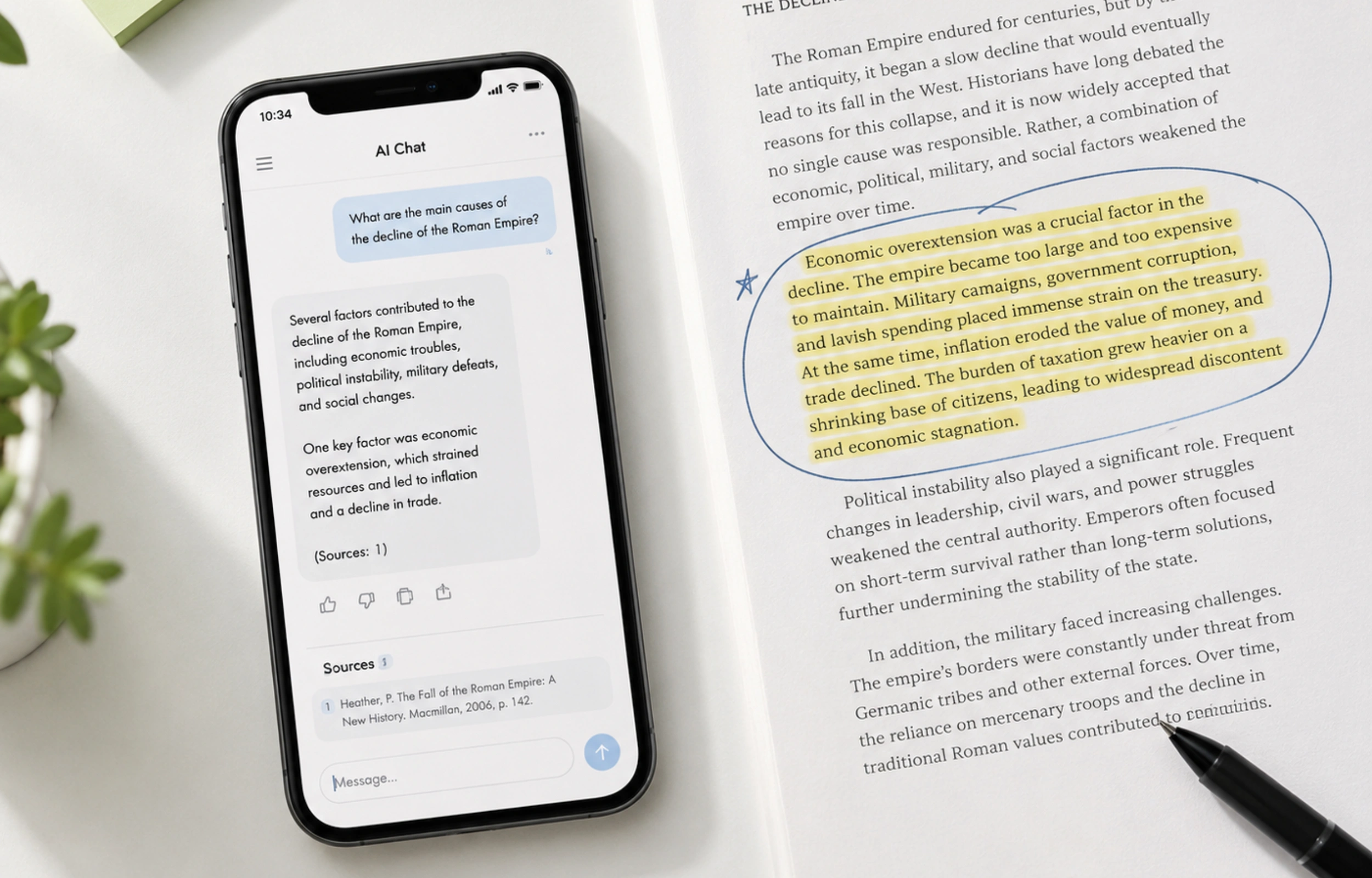
Answer Engine Optimisation is the practice of structuring content so that AI tools such as ChatGPT, Google AI Overviews, Perplexity, and Gemini can use it directly when generating an answer to someone's question.
Traditional SEO is built around a single goal: rank highly enough on a search results page that someone clicks your link. AEO has a different goal. It aims to have your content selected, summarised, or directly cited inside an AI-generated answer, sometimes without the person ever clicking through to your website at all.
The shift behind this is real and measurable. Google's AI Overviews now appear in roughly 55 percent of all Google searches. ChatGPT has grown to several hundred million monthly users. People are increasingly asking full, conversational questions rather than typing short keyword phrases, and getting a synthesised answer rather than a list of links to evaluate themselves.
Why This Matters Specifically for Local Service Businesses
This is the part of the AEO conversation that gets buried under generic marketing hype, and it is the part that actually matters for a business like yours.
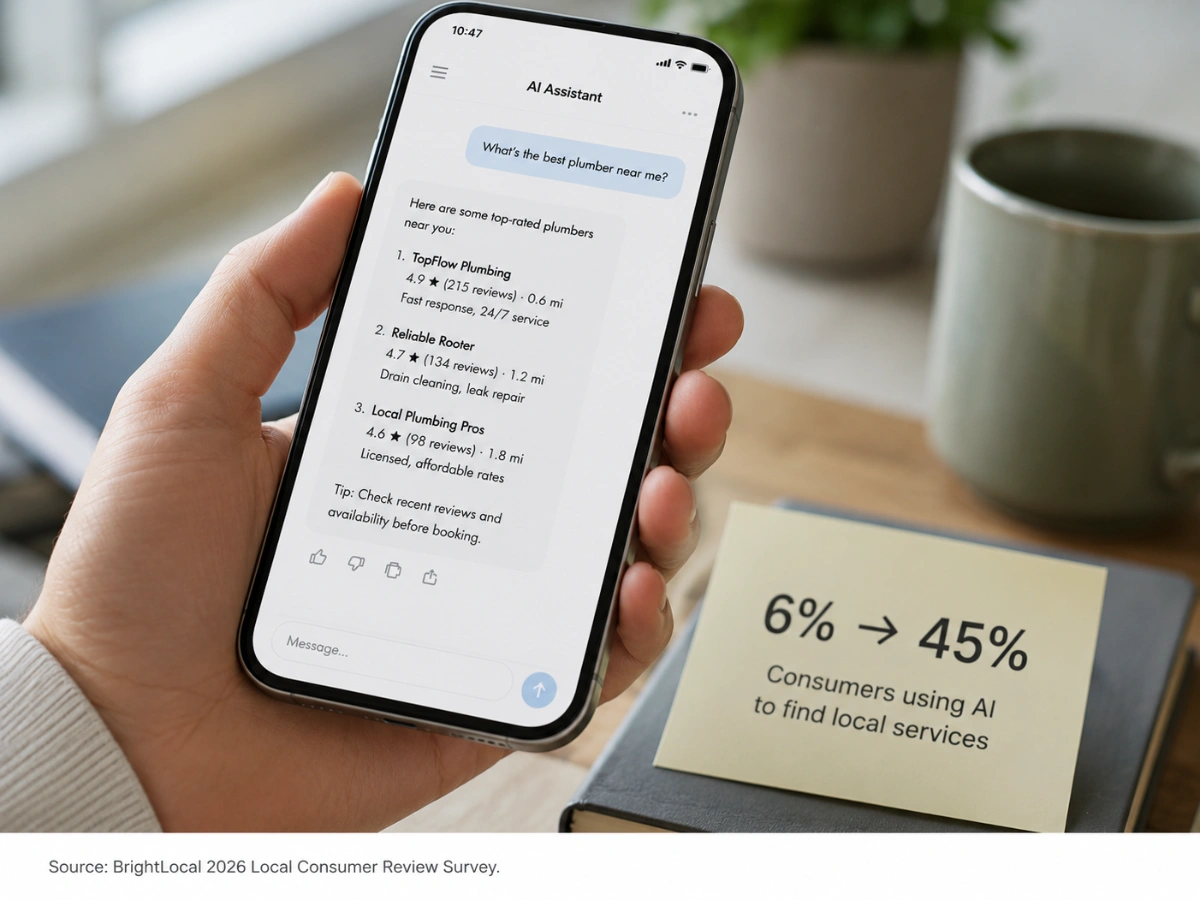
According to BrightLocal's 2026 Local Consumer Review Survey, the proportion of consumers using AI to find local services jumped from 6 percent in 2025 to 45 percent in 2026. That is one of the fastest shifts in consumer search behaviour ever recorded, and it means a meaningful share of the people looking for a service like yours are now asking an AI assistant rather than typing into Google and scrolling a list of results.
On those queries, there is no list of ten results to climb. The AI reads available sources, writes a short answer, and names one or two businesses. You are either in that answer, or you are invisible to that searcher entirely.
The opportunity inside this shift is significant precisely because almost nobody has acted on it yet. Research cited by the National Law Review in 2026 found that ChatGPT currently recommends only 1.2 percent of local business locations when asked, and that 88 percent of local businesses have no active strategy for appearing in AI search at all. Early movers in this space are not competing against an optimised field. They are competing against an empty one.
Wondering whether your content is structured to be cited by AI search tools?
Book a free discovery call with Hayley. Every WQ Creative blog post is built with AEO structure as standard, not as an afterthought.
How AEO Is Different From SEO, in Practical Terms
The good news for anyone already doing SEO properly is that AEO is not a separate discipline requiring an entirely new skill set. Most of what makes content perform well for AEO is an extension of what already makes content perform well for SEO and for readers.
The difference is a layer of additional precision. SEO rewards content that is relevant, well-structured, and authoritative enough to rank. AEO rewards content where every key fact and every answer to a specific question is independently clear enough that an AI system can lift it out, understand it correctly, and cite it with confidence.
In practice this means writing in a way that answers a specific question directly and early, rather than building up to the answer through a long narrative introduction. It means using clear headings that match the actual questions people are asking. It means structured data, particularly FAQ and LocalBusiness schema, that explicitly labels what your content is and what business it represents. And it means keeping facts about your business, your pricing, and your service area consistent everywhere they appear online, because inconsistency makes an AI system less likely to trust and cite you.
What This Means for Your Website and Content
Answer the question directly, early, in the content itself
If a page is meant to answer 'how long does SEO take for a service business,' the answer needs to appear clearly within the first few sentences of the relevant section, not buried at the end of a long preamble. AI systems retrieve and cite specific passages, not entire pages, so the passage containing the direct answer needs to stand on its own.
Use structured data that explicitly labels your business
LocalBusiness schema and FAQ schema are not optional extras for a service business serious about AEO. They give AI systems explicit, structured information about who you are, where you operate, and what specific questions your content answers, rather than asking the system to infer it from unstructured text.
Keep your facts consistent everywhere
Your business name, service area, pricing approach, and key differentiators need to say the same thing on your website, your Google Business Profile, your social profiles, and any directory listing. AI systems cross-reference these sources, and inconsistency reduces the confidence with which they will cite you.
Build genuine topical authority, not just keyword coverage
AI systems favour sources that demonstrate real depth on a specific topic over sources that have published widely but shallowly. A small business with a handful of genuinely thorough, specific posts on the exact questions its ideal client asks is a stronger AEO candidate than a business publishing generic content across dozens of unrelated topics.
What Is AEO and Should Service Businesses Care About It?
AEO, or Answer Engine Optimisation, is the practice of structuring content so AI tools like ChatGPT, Google AI Overviews, and Perplexity cite it directly when answering a question. Service businesses should care because nearly half of consumers now use AI to find local services, and most local businesses currently have no strategy to appear in those answers. AEO does not replace SEO. It extends it, rewarding the same fundamentals of clarity, structure, and trust that good SEO already requires.
What AEO Does Not Change
It is worth being honest about what AEO does not do, because some of the marketing language around it overstates the shift.
AEO does not replace the need for a fast, well-structured, technically sound website. If anything, it raises the bar, because both traditional search engines and AI systems reward the same underlying technical quality. A slow, poorly structured site will perform worse in both environments, not just one.
AEO also does not replace the need for your website to convert visitors once they arrive. Being cited in an AI answer might bring someone to your site at a later, more decided stage of their research than a typical cold search visitor, which is a genuine advantage. But if the site they land on does not clearly communicate who you serve and what to do next, that advantage is wasted.
And AEO does not mean abandoning a long-term content strategy in favour of chasing AI citation tactics. The businesses performing well across both search and AI answers in 2026 are the ones that have been consistently publishing genuinely useful, specific content for a while. AEO rewards that foundation. It is not a shortcut around building it.
Where to Start, Practically
If you want to take a first step on this without overhauling everything at once, three actions produce the most value relative to the effort involved.
Add FAQ schema to your highest-traffic existing pages, particularly any page that already answers a clear, specific question. Review your Google Business Profile and ensure your business description, services, and contact details are complete and consistent with everything else published about your business online. And when writing new content, lead with the direct answer to the question in the heading and the opening sentences, rather than building up to it gradually.
None of this requires specialist AEO software or a separate budget line, at least to begin with. It requires the same discipline that good SEO and good content writing have always required: be specific, be clear, and be consistent.
Built for search engines and answer engines, from the start.
Every website and blog strategy at WQ Creative is structured with schema, clear answer formatting, and local SEO signals built in, so your business is positioned for both classic search and the AI tools increasingly shaping local discovery. Book a free discovery call with Hayley.



.png)