There is a version of this post that just tells you blogging is alive and well, backs it up with a few statistics, and sends you off feeling good about your content plan.
I am not going to write that post.
Because the honest answer is more complicated, and if you are a service business owner trying to decide whether to invest time in blogging, you deserve the real picture, not the reassuring one.
Here is what I know: blogging is not dead. But the way most small businesses do it absolutely is. And the difference between those two things is worth understanding before you commit to a content strategy for 2026.
What Has Actually Changed
Search has shifted significantly. Google's AI Overviews now appear in roughly ten percent of all desktop searches, and more than half of all Google searches end without a click to any website at all. That is not a small change. For businesses that built their entire content strategy around organic traffic, those numbers are genuinely alarming.
For context: independent research has found that when an AI Overview appears on a results page, click-through rates to websites drop by between 35 and 47 percent compared to searches without one. Large publishers are reporting dramatic traffic losses. Some blogs in highly generalist niches have seen organic reach fall off a cliff.
So yes, something has changed. The question is whether any of that change is relevant to a service-based small business in Australia. And mostly, it is not.
Here is why.
The Content That Is Dying and the Content That Is Not

The blogs taking the hardest hit from AI Overviews are the ones that answer generic, surface-level questions. How-to guides. Definition posts. Comparison content. Anything where an AI can synthesise a useful answer from ten different sources and serve it directly in the search results without the user ever needing to click.
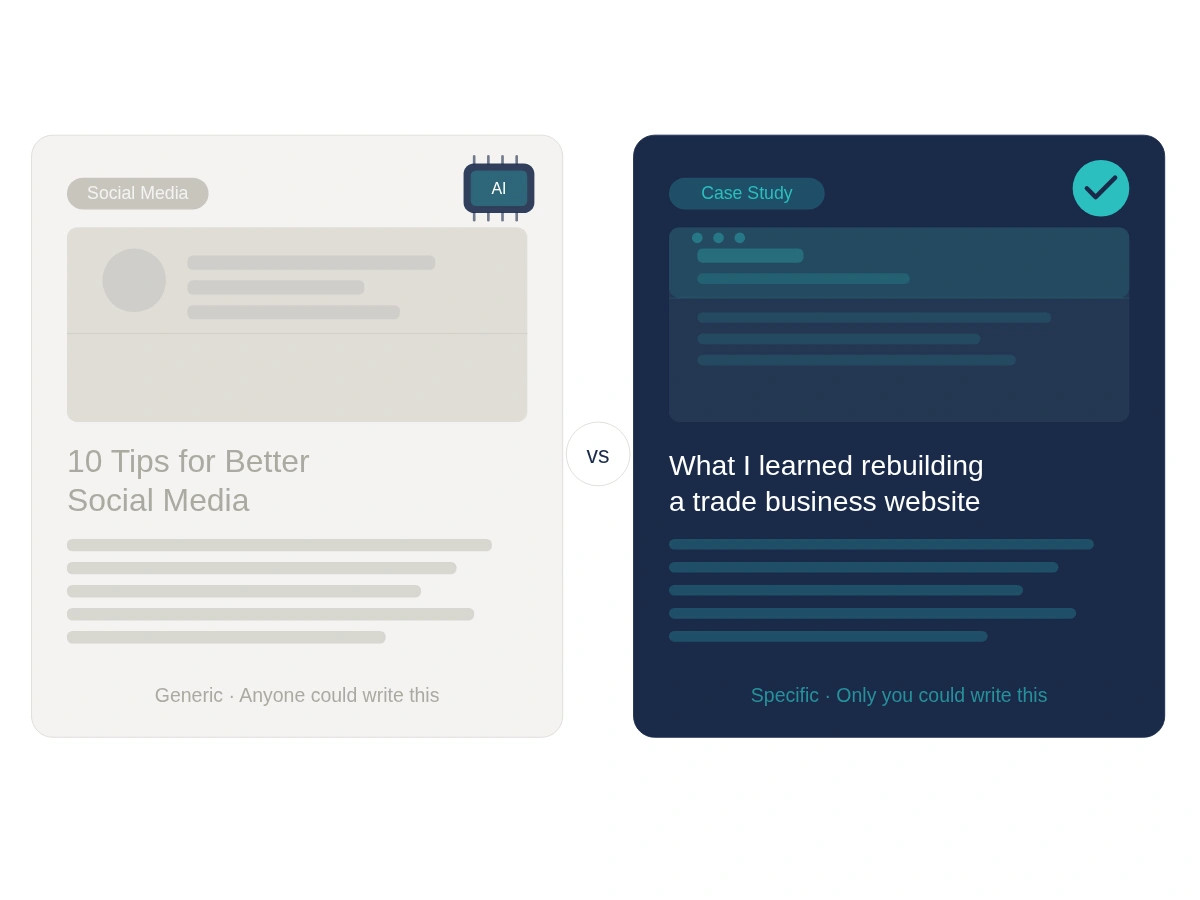
If your blog strategy is built on 'ten tips for better social media' or 'what is brand identity', that content is under real pressure. Not because it is badly written, but because a language model can replicate its value in three sentences.
What AI cannot replicate
Specific experience. Real client outcomes. The particular perspective that comes from having done this work, in this market, for this kind of client, for years.
A post about what I learned rebuilding a local accountant's website from scratch and why their bookings increased by forty percent in three months is not a post an AI can write. It contains proprietary knowledge. It has a point of view. It reflects genuine expertise in a specific context.
That is the kind of blogging that still works very well. Not because the algorithm favours it, but because the reader does. And for service businesses, the reader converting into a client is the only metric that matters.
Not sure what your blog should actually be about?
A good content strategy starts with knowing what your ideal client is actually searching for. Book a free discovery call and we can work through it together.
wqcreative.au/contact
The Real Job of a Service Business Blog
Most small business owners think about blogging in terms of traffic. More posts equals more visitors equals more leads. That logic made sense ten years ago. It makes less sense now.
For a service business, the blog's primary job is not to be found by strangers. It is to convert the people who find you through any channel into someone who trusts you enough to make contact.
Think about how your ideal client actually behaves. They might find you through a referral, a social post, a directory listing, or yes, a Google search. Before they get in touch, they look at your website. They read about what you do. They try to get a sense of who you are and whether you know what you are talking about.
A strong blog answers all three of those questions without the client having to ask. It demonstrates expertise. It shows personality. It gives the reader the evidence they need to feel confident reaching out.
Positioning over traffic
This is a fundamentally different reason to blog. And it completely changes what you should be writing about.
You are not trying to rank for everything. You are trying to be the obvious choice for your specific client. That means writing about the problems they actually have, in the language they actually use, with the specific knowledge that only you can bring.
A Brisbane-based brand designer who writes about the particular challenges of rebranding a trade business is not competing with HubSpot for generic marketing traffic. She is building a content library that speaks directly to the client she wants, and it will keep doing that work for years.
How Often Do You Actually Need to Post
This is the question that stops most service business owners before they start. The idea that you need to post three times a week to see results is a myth that predates everything that has happened in search over the past two years.
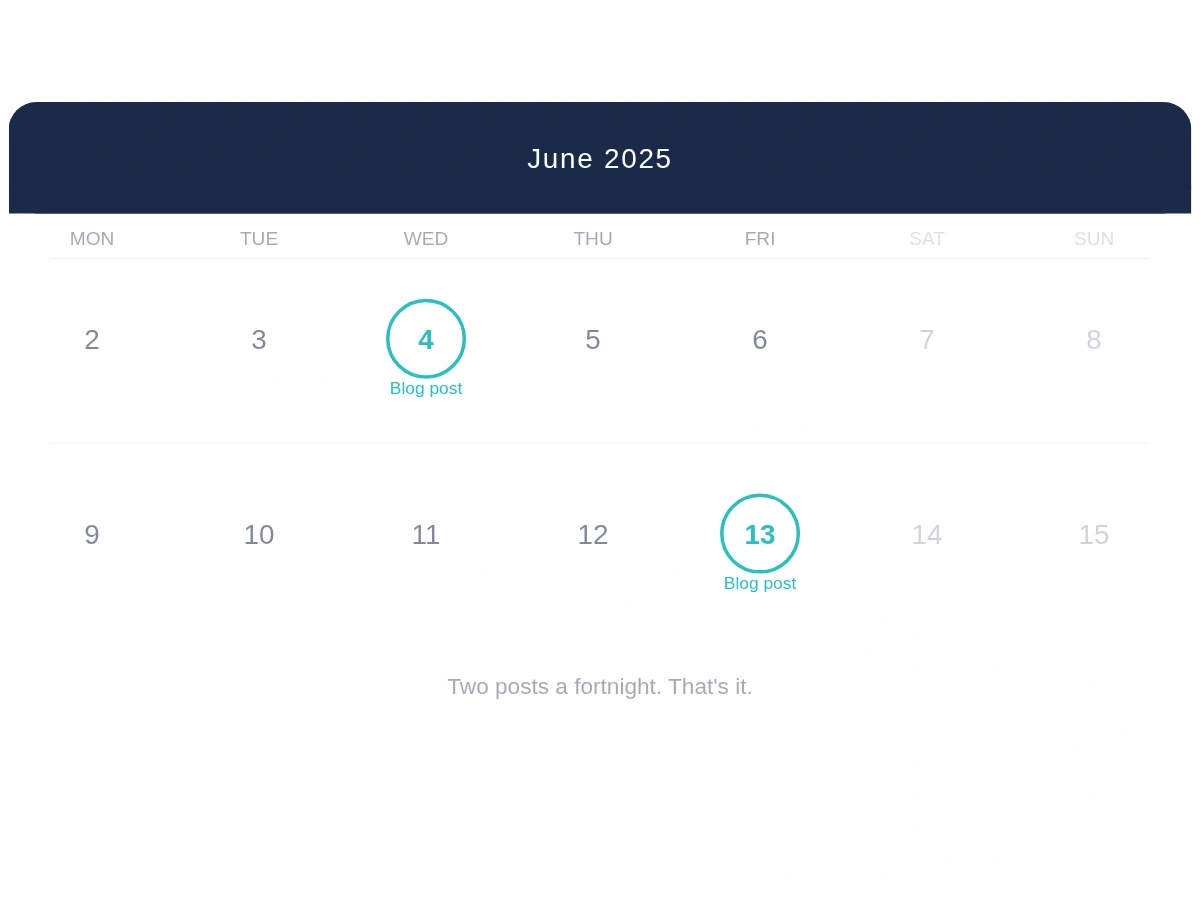
Current data consistently shows that one to four well-researched, properly optimised posts per month outperforms daily publishing of thin, generic content. Quality has beaten quantity for a while. Now it is not even close.
For most service businesses, two strong posts per month is a realistic and genuinely effective goal. That is a 600 to 1200 word post every fortnight, written from real experience, on a topic your ideal client is actually thinking about.
That is not a massive time commitment. And if writing is genuinely not your thing, it is also something you can outsource once you have a clear strategy in place for what to write about and why.
Should Service Businesses Still Blog in 2026?
Yes, but only if you do it with a clear strategy. Generic content no longer performs. What still works is specific, experience-led writing that reflects real expertise, answers real questions, and builds the kind of trust that converts a reader into a client. For service businesses especially, a blog is less about traffic and more about positioning.
The businesses seeing the weakest returns from blogging right now are the ones treating it as an SEO game. Publishing for volume, writing for algorithms, chasing keywords with no genuine perspective to offer.
The businesses seeing strong returns are the ones writing from real experience, on specific topics, for a clearly defined client. They are not worrying about whether AI Overviews will steal their traffic. Their content is doing something an AI summary cannot do: it is building a relationship.
One More Thing Worth Saying
If your website is not clear, fast, and designed to convert, a blog will not save it. Content works in service of a strong foundation. If someone clicks through from a post and lands on a confusing, outdated, or poorly structured site, the blog has done its job and the website has let it down.
That is why brand and web strategy always comes before content strategy in my work. Not because content does not matter, but because content is only as effective as the platform it lives on.
If you are blogging and not seeing results, the problem may not be the blog. It may be what people land on when they finish reading it.
Want a blog that actually works for your business?
At WQ Creative, we build the brand and website foundation first, then help you develop content that brings your ideal client from curious to confident. Book a free discovery call with Hayley.


.png)
.jpeg)