Brand voice and tone of voice get used interchangeably in almost every conversation about branding. They are not the same thing. And the confusion between them is why a lot of businesses end up with messaging that feels inconsistent even when they think they have a defined voice.
This post is a clear explanation of both concepts, how they relate to each other, and what the practical difference looks like in your actual communication. If you have ever written something that technically sounds like your brand but still feels slightly off, the answer is usually in this distinction.
Brand Voice: The Constant
Your brand voice is the personality your business expresses consistently across everything it communicates. It is rooted in your values, your positioning, and the particular way your business sees the world. It does not change based on what you are writing or who you are writing to.
Think of it this way. A person has a character. That character is recognisable whether they are presenting to a room full of strangers, catching up with a close friend, or writing a formal letter. The words they choose and the energy they bring might shift depending on the context, but the underlying personality stays the same. Brand voice works the same way.
A service business with a direct, no-nonsense brand voice should sound direct and no-nonsense whether it is writing a website headline, an email subject line, or an Instagram caption. The directness is the constant. That is the voice.
What brand voice is not
Brand voice is not a list of adjectives on a mood board. 'Professional, warm, and approachable' is a description that could apply to almost any service business. A useful brand voice goes further than that. It captures the specific way this particular business communicates: what it says, what it does not say, the words it reaches for, the words it avoids, the stance it takes on things that matter to its audience.
The test of a well-defined brand voice is not whether it sounds good in a brand guidelines document. It is whether someone who has never written for your brand can pick it up, read the guidelines, and produce copy that sounds unmistakably like you. If the guidelines are too vague to make that possible, the voice is not defined clearly enough yet.
Tone of Voice: The Variable
Tone of voice is how your brand voice expresses itself in a specific context. It is the emotional register of a particular piece of communication, shaped by the situation, the audience's state of mind, and what you are trying to achieve with that specific message.
Your tone will and should shift across different types of content. A welcome email to a new subscriber can afford to be warmer and more conversational than a sales page. A post addressing a common misconception in your industry might have an edge that a general how-to post does not. A message to a client going through a difficult situation calls for more care and less efficiency.
None of those tonal shifts undermine your brand voice. They are expressions of it. The same underlying personality, adapted to serve the specific communication moment.
A practical example
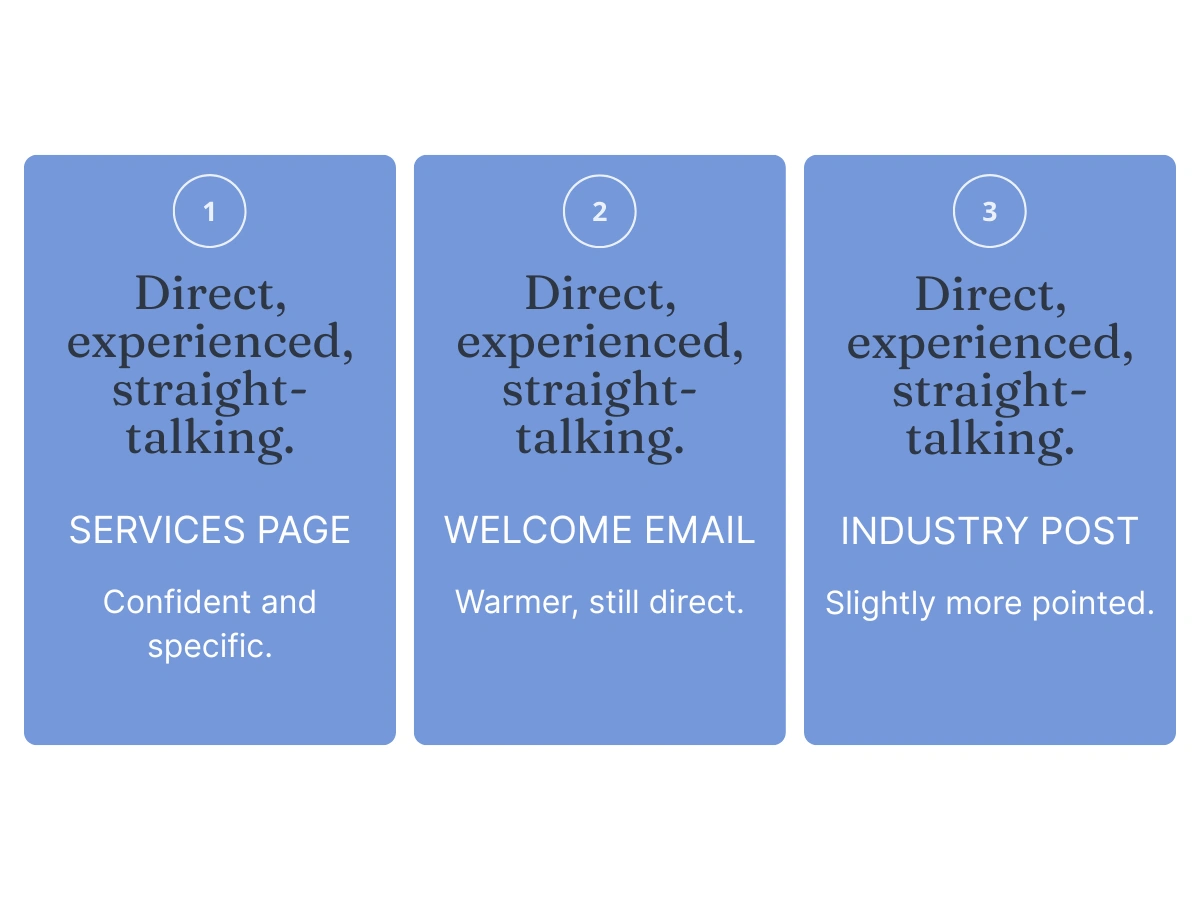
Say your brand voice is direct, experienced, and straight-talking. Here is what that sounds like across three different contexts:
On your services page: 'We build brand and web strategies for service businesses that are ready to stop underselling themselves.' Confident, specific, no padding.
In a welcome email to a new subscriber: 'Good to have you here. I write about brand strategy, web design, and the gap between how good your work is and how well your business communicates that. If that resonates, you are in the right place.' Warmer, but still direct. No fanfare.
In a post about a mistake you see constantly: 'Most service businesses build the website before they have figured out what the website needs to say. Here is why that keeps producing the same result.' Slightly more pointed. The directness has a bit of edge because the topic calls for it.
Same voice. Three different tones. The brand is recognisable in all three.
Not sure your brand voice is actually defined well enough to guide your communication?
Brand strategy at WQ Creative includes voice definition as a core deliverable. Book a free discovery call with Hayley to talk through what your brand currently sounds like and where the gaps are.
Why the Distinction Matters in Practice
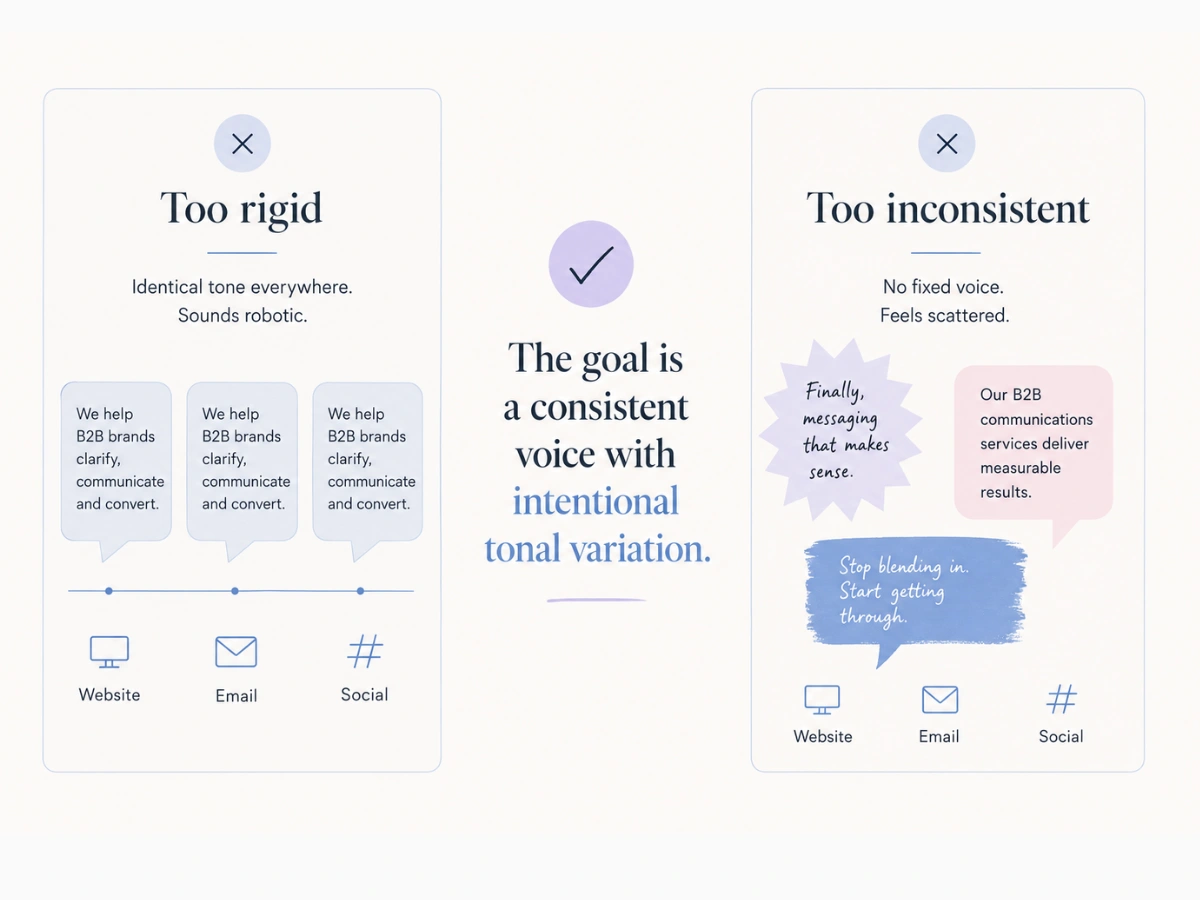
When brand voice and tone of voice are confused, two things tend to go wrong.
The first is rigidity. The business defines its brand voice and then tries to sound identical across every piece of communication. Every email, every post, every page on the website uses the same register. It reads as flat and slightly robotic because it has no tonal variation. Humans do not communicate that way, and brands that do feel less human as a result.
The second is inconsistency. The business understands that different content needs a different feel, but without a clear underlying voice, every piece ends up sounding slightly different from the last. The website sounds one way, the emails sound another, the social content sounds like a third person wrote it. There is tonal variation without a consistent foundation, and the brand feels scattered.
Getting both right means having a clearly defined voice that acts as the fixed point, and then consciously adapting the tone based on context, without ever losing the underlying personality. That combination is what makes a brand feel both consistent and human.
The content types where this matters most for service businesses
Website copy is where your brand voice needs to be clearest and most consistent. Every page should sound like the same business. Homepage, about page, services page, blog, the voice should be recognisable across all of them even as the tone shifts slightly between a conversion-focused services page and a more conversational blog post.
Email communication is where tone earns its keep. A client email, a newsletter, an automated sequence, and a proposal all need different registers. Getting the tone right in client communication in particular builds the sense that the person they hired actually pays attention to context, which builds trust faster than almost anything else.
Social content is where brand voice tends to slip the most, because the informal nature of most platforms encourages a different style of writing. The risk is that social content ends up sounding nothing like the website, and a prospect who finds you on Instagram and then visits your site feels like they have landed somewhere different. The voice should be recognisable on both, even if the tone is more relaxed on social.
How to Define Your Brand Voice Clearly Enough to Actually Use It

A brand voice that lives only in someone's head is not a brand voice. It is an intention. To be useful, it needs to be documented clearly enough that someone else could pick it up and use it.
Start with the three things that tend to define voice most clearly.
What your brand consistently says. The positions it takes, the things it believes, the perspective it brings to the problems its clients face. Not slogans. The actual point of view.
What your brand does not say. The words it avoids, the tone it does not take, the things it deliberately chooses not to do. For WQ Creative, that means no exclamation marks used for effect, no coaching-speak, no emojis in professional copy. The avoidance list is often more defining than the positive description.
Real examples, marked up. Take a piece of copy you are happy with and one you are not, and annotate why. What makes the good one work? What is wrong with the other? Pattern recognition built from real examples is faster and more reliable than abstract descriptions of personality traits.
Once those three things are documented, you have a working voice guide. It will not be perfect immediately. Voice definition is something you refine as you write more and get clearer on what sounds right and what does not. But having it written down means decisions get faster and more consistent over time.
What Is the Difference Between Brand Voice and Tone of Voice?
Brand voice is the consistent personality your business expresses across all communication. It does not change. Tone of voice is how that personality adapts to different situations: warmer in a welcome email, more direct on a sales page, more careful in a difficult conversation. The voice stays fixed. The tone shifts. Understanding this distinction is what allows a brand to feel consistent everywhere without sounding identical everywhere.
A Note on Documentation
One of the clearest signs that a business does not have a properly defined brand voice is that the founder is the only person who can write in it. Everything has to go through them because there is no documented reference point anyone else can use.
That is a bottleneck that gets more expensive as the business grows. Every piece of copy that needs to be reviewed and rewritten, every VA who cannot quite nail the tone, every social post that gets deleted and redone adds up. A clear, documented voice guide removes that bottleneck. It is an asset that pays for itself quickly.
It does not need to be a lengthy brand guidelines PDF. A two-page document with clear examples is more useful than a thirty-page document that nobody reads. The goal is something someone can actually refer to in the moment they are writing, not something that sits in a folder and gets opened once.
A brand that sounds like itself is a brand people remember.
Brand voice definition is part of every brand strategy project at WQ Creative. If your communication feels inconsistent or you are the only person who can write in your brand's voice, that is a good place to start the conversation.